
Proposition 36 - A Turning Point or the Beginning of Another Debilitating Political Battle?
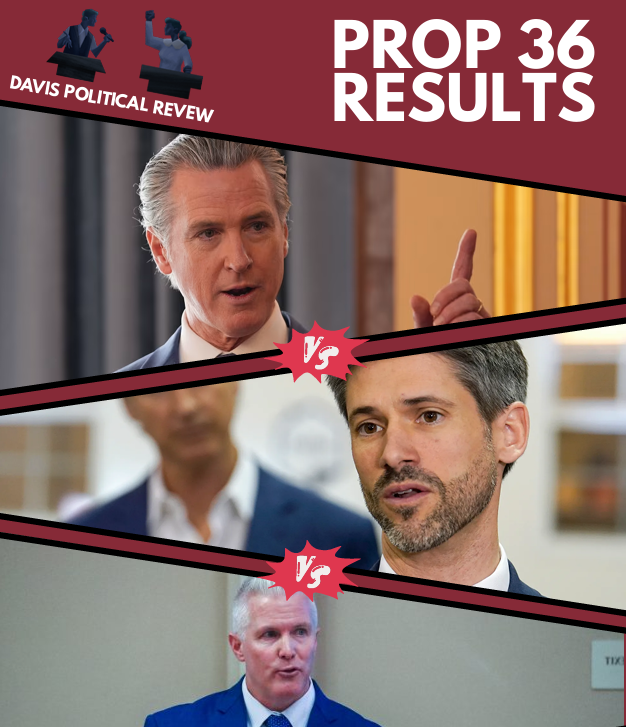
Art Credit: Mai Presser
Introduction
In November 2024, on the same ballot that reelected President Trump, California voters quietly and overwhelmingly passed Prop 36, partially repealing the criminal justice reforms they had greenlit just a decade ago. Despite the fact that Prop 36 was popular among California voters, its passage in a landslide still shocked many, especially those with high optimism in criminal justice reforms. Prop 36 increases penalties for a number of drug-related crimes and theft. It makes drug trafficking sentencing based on the amount sold, and mandates that these inmates serve in prison instead of county jail. Additionally, Prop 36 creates “treatment-mandated felony,” which gives the convicted a choice between treatment and up to three years in jail or prison. Opting into treatment would mean entering a plea of guilty or no contest, and completing the treatment would have the charges dismissed.
In 2024, California, along with the rest of the nation, witnessed a sharp right turn in a number of policy issues. Voters become more sympathetic towards tough-on-crime stances, partially in reaction to rising homelessness and seemingly rising crime. However, it is debatable whether this shift is accompanied by concrete policy demand or simply an emotion-driven, periodic turn. The implementation of Prop 36 has diverged from the expectations of many voters, local prosecutors, and law enforcement officials. Governor Newsom and the legislature brawled over the Prop 36 funding, as there were no concrete funding mechanisms in any Prop 36 provisions.
Prop 47 Revisited
A decade ago, California voters passed Prop 47, a signature criminal justice reform proposal. Prop 47 downgraded some drug offenses and theft from felony to misdemeanor, authorized those convicted of drug and property-related felonies to seek resentencing, and allowed those already convicted to change their status.
Through Prop 47 and a series of measures, California has committed to reducing its prison population after decades of mass incarceration. Since Prop 47, local governments in California managed to save tens of millions from reducing prison beds, and reinvested the money to fund mental health treatment, addiction treatment, and education programs.
As Prop 36 is poised to undo a number of criminal justice reforms, it is certain that California will have to embrace a surge in the imprisoned population. According to the Legislative Analyst’s Office, in 2025, Prop 36 is expected to increase the state prison population by 33,00 (4%). This will also most likely drive up prison costs and reduce state spending on other criminal justice programs.
Funding and Public Demand
Since the COVID-19 pandemic, many municipalities struggled with economic recovery. Job losses and rising cost of living leave an unprecedented number of Californians on the streets and falling into addiction. California voters do not need data or news articles to understand the extent of homelessness or crime on the streets. Nevertheless, the media never ceases to display the rampant drug consumption, theft, robbery, and even murders on the street. From the killing of 84-year-old Vicha Ratanapaktee in San Francisco to a number of stabbings in BART stations. These incidents seem to be calling for the return of “law and order,” first championed by another legendary California politician, Richard Nixon.
Governor Gavin Newsom and the state legislature negotiated a one-time budget allocation of $100 million; however, the legislature originally requested $600 million to fund Prop 36 annually. According to the California Judicial Council’s report, as of June 30, 2025, out of 8895 individuals charged with a treatment-mandated felony, 1290 elected to opt in to treatment, 771 have begun treatment, and 25 people had their charges dismissed after completing treatment. This demonstrates a significant discrepancy between people willing to receive treatment and those who are able to receive it.
A number of local law enforcement authorities have criticized the state government for failing to fund Prop 36. Yolo County District Attorney Jeff Reisig stopped introducing defendants to Prop 36 programs, calling out a lack of funding. To a large extent, these criticisms are merited in emphasizing the importance of public opinion. As Prop 36 came into effect with a sizable mandate, voters elected to see it properly implemented. Regardless, we must ask: How was Prop 36 proposed without paving the way to fund itself?
The Political Motor Behind “Law and Order”
While public sentiment might not strictly correlate with the social statistics, it is instrumental in pushing politicians to prioritize certain policy areas and push. Big money is inevitable in our politics. These well-funded, business-oriented political movements often exploit short-term fanaticism over a political topic, prioritizing style over substance.
San Jose Mayor and Democratic California Governor Candidate Matt Mahan, a major proponent of Prop 36, argued that Prop 36 serves as a “forcing function” for the state and local governments to invest in large-scale treatment options. However, the forcing function comes at a cost. The Legislative Analyst’s Office warned that Prop 36 would increase the fiscal responsibility of state and local governments in administering treatment, as well as jail, prison, and court operations, by tens of millions, if not hundreds of millions.
With Governor Newsom’s opposition to Prop 36, the lack of a funding mechanism warrants him to defer the funding responsibility to -- no one. A California law does not have to include a funding mechanism to pass, but many do to help balance the $300 billion+ state budget. The California Constitution requires the state to reimburse local governments for state mandates. However, the state government is only required to fund state-approved mandates, not voter-approved ones. As a result, there exists a fundamental rift between the voters’ will and the state government’s responsibility when the government disagrees with constituents. The issue of “unfunded mandate” is not news in California. For example, as local school boards comply with mandatory state programs, the state government frequently avoids reimbursements by not including them in the state budget. As voters, regardless of our stance on criminal justice issues, we should demand answers on funding before approving or denying such a sweeping reform. As it has demonstrated in Yolo County, funding shortages could turn Prop 36 into a different, unknown species.
Takeaway and Progress
Regardless of the criticism of Prop 36’s lack of a funding mechanism, it is a bewildering concept to argue that California voters demanded Prop 36 but did not wish to see it adequately funded. In a representative democracy, politicians must fulfill voters’ popular mandate within the legal framework. California has been a pioneer of participatory referendum for more than a century. Former Governor Hiram Johnson commented that (the power of initiative, referendum, and recall) “do give to the electorate the power of action when desired, and they do place in the hands of the people the means by which they may protect themselves.”
Pleasingly, we are seeing a surge in political discussions within the California Politico, shifting from virtual signaling to practical policy issues. Despite the Democratic Party’s domination over California politics, its internal dialogue offers rising hope that it will strive for better policy solutions. By focusing on regional and practical issues - helping those with addictions, putting a shelter above the unhoused, and trimming bloated state budgets - these political discussions, even if fiercely divided, turn our politics from defiance to discovery, from contempt to compassion.
It is too early to call Prop 36 a success or failure. Regardless, rejecting a popular proposal through political means is undemocratic and undermines one of the unique features in California political system. As California brands itself in the intensifying fight to preserve democracy in our nation, it must not erode democracy when politicians find it inconvenient. On the bright side, from the heated campaign process to dramas in Sacramento, as informed voters, we can learn a lot from ourselves and our representatives. Good-conscience politicians often derive from a more informed, vigilant, and active constituency.