
Looking Back at Latin American Elections in 2025, and What’s in Store for 2026
Art Credit: Asees Bhullar
This article contains mentions of Sexual Assault.
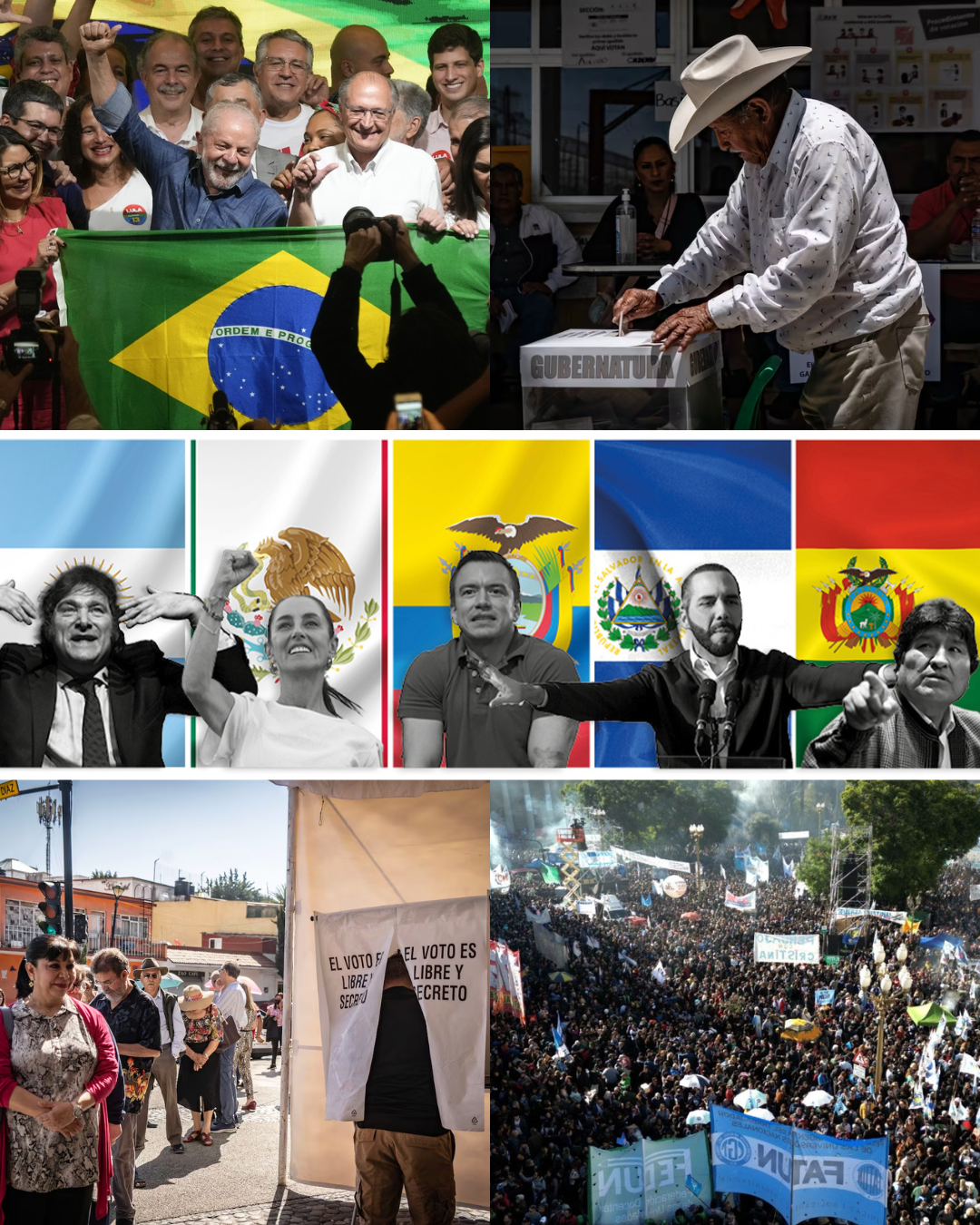
This past year has no doubt been an incredibly interesting one regarding the outcome to the litany of elections held across the region. Ecuador held extremely contentious elections in which the conservative incumbent Daniel Noboa secured a comfortable re-election victory, defeating his main left-wing challenger, Luisa González, in an election dominated by issues of crime and government corruption. Later in the year, Ecuador hosted a series of referendums, one of which asked voters whether they wished to repeal a ban on the installation of foreign military bases in the country, with over 60% of voters turning down the offer in what was seen as a rejection of U.S. foreign policy in the country.
Venezuela held legislative elections in which the governing United Socialist Party of Venezuela (PSUV) secured nearly 90% of the seats in the National Assembly after mainstream opposition parties made the decision to boycott these elections, despite winning a super-majority in the previous legislative elections in what was then seen as a massive victory for opposition parties and a repudiation of President Nicolas Maduro, claiming that the elections were illegitimate and that the electoral watchdog in charge of organizing and administrating elections is fraudulent and controlled by Maduro’s cronies.
Mexico held judicial elections, the first of its kind. These elections took place a little over a year after the approval of extremely controversial judicial reforms which saw a weakening of the judiciary’s independence by altering the appointment-based nature of judicial appointments with elections, with lawyers and various members of the country’s judiciary going on strike and organizing mass demonstrations against the reforms. The judicial elections saw hundreds of federal circuit-court judges and Supreme Court (SCJN) justices up for election. Results showed a clean sweep for judges and justices backed by the governing coalition of left-wing parties, in addition to presidents Andres Manuel Lopez Obrador and Claudia Sheinbaum, despite nationwide turnout sitting at a mere 13%.
Honduras wrapped up elections last November in which the conservative, Trump-backed candidate Nasry Asfura narrowly eked it out over the liberal anti-corruption firebrand Salvador Nasralla.
This came after Trump endorsed Asfura, tying aid to the Central American country to Asfura’s victory. After weeks of vote counting, a multitude of fraud allegations from supporters of Nasralla and the leftist Rixi Moncada, with the now former left-wing president Xiomara Castro calling the results an ‘electoral coup’.
2026 does not get any less busy for the region. Four major Latin American countries are set to hold elections this year.
Colombia holds elections for its Senate, Chamber of Deputies, and Presidency in what is seen as a battle for the struggling Colombian Left and incumbent President Gustavo Petro, who at the global stage has been one of the leading voices against the Trump administration and its support for Israel’s genocide in Gaza, having cut off diplomatic ties with Israel in their entirety and encouraging U.S. soldiers to resist orders from higher-ups (something that ended in the revocation of Petro’s visa).
Brazil, the largest country in Latin America, will be hosting the First round of its presidential election in October, in addition to electing 517 Deputies, 81 Senators, and gubernatorial elections in the 27 federal entities, and a second round, if necessary, a month later. Brazil has gone through what could only be described as a rollercoaster from hell in the world of politics over the past 10-12 years: the Operation Car Wash scandal broke, leading to an entire domino effect of massive political figures falling from grace, including but not limited to the extrenemy controversal impeachment of Dilma Rousseff, the conviction of Lula da Silva (which was later annulled due to massive issues with the trial) mere weeks before the 2018 elections, Jair Bolsonaro’s victory– and the absolute trainwreck that was his presidency, only for his principal rival, Lula da Silva, to come back and defeat Bolsonaro in the 2022 elections, with Bolsonaro supporters storming the Brazilian capitol days after Lula was inaugurated.
This time, it looks like the elections will be between two candidates– incumbent Lula da Silva, and Jair Bolsonaro’s oldest son, Flavio Bolsonaro. Currently, opinion polling and betting markets suggest a scenario where Lula da Silva faces Flavio Bolsonaro and wins by double-digit margins. In either the first or second rounds.
This past Sunday, Costa Rica elected staunch conservative Laura Fernandez Delgado by a nearly 15pp margin over her closest rival, center-left Álvaro Ramos Chaves, in addition to giving her right-wing Sovereign People’s Party (PPSO) 30 of the 57 seats in the Legislative Assembly. Fernandez, who was backed by the outgoing president Rodrigo Chaves, largely campaigned on a platform of cracking down on crime and drug trafficking after a recent spike in incidents grappled the country, somewhat conflicting with its image as a peaceful nation that has been spared from the violence grappling its neighbors.
Moving onto Peru, whose recent political history is nothing short of bewildering. From repeat nail-biter margins between Keiko Fujimori and whichever opponent she faced, constant impeachments, the election of Pedro Castillo and subsequent attempt at a self-coup, leading to his first Vice President, Dina Boluarte succeeding him and leading what is perhaps one of the most unpopular administrations in the regions history.
Boluarte, as president, was massively unpopular, polling at 2% in approval ratings, constant protests which saw the massacring of anti-Boluarte protestors, the impeachment of Boluarte by Peru’s National Congress and replacement with José Jerí, who earlier last year was publicly accused of sexual assault at a New Year’s party, though the investigation was quickly dropped by Peru’s Attorney General, citing a lack of evidence.
Peru, with a population roughly the size of Texas, has had the same challenges that many other Latin American nations have faced. Massive surges in inequality, violent crime, in addition to a massive population of Venezuelans who fled the regime of Nicolas Maduro, is unlikely to see any reprieve from the chaos the South American nation faces, with over 30 candidates and counting at the time of writing this article. And again, Fujimori is running, currently polling in 2nd place, though it should be noted that many of these polls have her in the single digits, with the bulk of voters in polls being undecided or not expressing a preference for any of the registered candidates.
This is, without a doubt, a scary and tumultuous time for Latin America and the globe. The long-standing problems of violent crime and drug trafficking are more entrenched than ever, with support for draconian policies as high as it's ever been, more and more people are growing afraid to leave their homes.Poverty continues to be as widespread as ever. The institutions intended to protect, defend, and serve the people are either failing in their jobs or are nowhere near fortified and strong enough to do their jobs. Social trust is breaking down. People are feeling increasingly isolated and failed by leadership. Time will only tell if the right, progressive, transparent, level-headed people will rise to lead Latin America, a region of the world which I truly believe does not get the attention, and quite frankly the love it deserves, into times that will be even more testing for not just the region, but the entire world.