
Why isn’t the Election of Japan’s First Female Prime Minister regarded as a Feminist Victory?
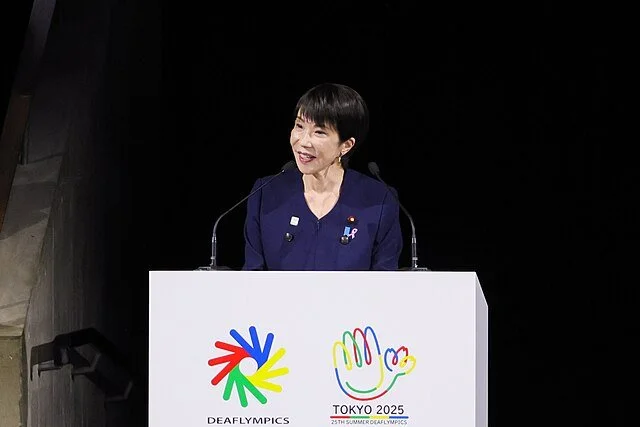
Photo Credit: 内閣広報室
Introduction
On October 25th, Japan elected its first female Prime Minister, Sanae Takaichi, in a landslide victory in Parliament. Unlike political wins for other women, Takaichi’s win has received mixed reactions from prominent feminists all over the globe for her extreme, far-right, conservative values. Since 1993, Takaichi has been a leading figure within Japan’s Liberal Democratic Party (LDP). Her victory, which was supposed to break historical barriers in the glass ceiling, has instead signified a shift to the right for the historically moderate party.
Background of the LDP and Japan’s Rightward Shift
Despite Takaichi’s decisive majority in both the upper and lower houses, her win followed a period of intense uncertainty for the LDP. Since its founding, the LDP has operated using a network of internal factions whose chief executives often compete for power and influence, functioning like sub-parties within the organization. The chief executives help members of the factions win elections and secure government positions. In exchange, members raise funds to support the party’s chief in the Prime Minister elections. The future of this long-standing system had already been cast into doubt in November 2023, when reports revealed that several LDP lawmakers had illegally concealed more than ¥600 million (about 3 million USD) in campaign funds through slush accounts. The slush fund scandal led to a significant erosion of public trust and a sweeping purge of the LDP’s top executives. The faction’s chief executives in charge of policy and parliamentary affairs were fired and replaced, and the former Prime Minister, Fumio Kishida, resigned after his attempts to reunify his administration failed in the eyes of the public. Public opinion polls revealed that Kishida’s cabinet had the highest disapproval rate since 1947, reflecting the deep disillusionment the public felt. The backlash from the scandal left the party politically isolated and paved the way for the collapse of their alliance with long-time coalition partner, the Komeito Party.
In addition to the public’s frustration with the government, high costs of living and the spread of misinformation online gave way to the rise of ultra-right conservatism in Japan. Amidst record-high inflation rates and falling salaries, populist parties all over Japan gained traction, spreading a nationalist, “Japan First” agenda, which warned against the “silent invasion of foreigners” and blamed them for the country’s economic troubles. With its legitimacy shaken and growing populist sentiment on the rise, the LDP turned to the right-leaning Japanese Innovation Party (Ishin) to establish a new alliance and secure a new governing majority. By striking a deal with Ishin, the LDP shifted away from its long-established centrist principles and embraced a far-right ideology. It was due to this political realignment that Takaichi was able to secure victory, campaigning on a platform that emphasized “Japan First” sentiments and advocated for stricter anti-immigration laws. Her victory marked a historic moment in Japanese politics, not because it symbolized her ability to break the glass ceiling, but because it represented the ascendancy of populist sentiment and the willingness of established parties to compromise their values for political gain in Japan. In doing so, it set the stage for the upset reactions of many grappling with what kind of progress her leadership truly represents.
Feminist Backlash
For years, Japan had ranked the lowest out of the world’s most advanced economies in the Gender Gap Index, primarily due to its lack of female representation. The historically patriarchal society had made gender parity a serious issue for the nation. Public opinion polls suggested that the majority of the public wanted a female Prime Minister. Yet, in spite of this, Takaichi’s victory did not receive the feminist ovation it seemingly intended to. Prominent feminists all over the globe have criticized Takaichi for her own complicated views concerning gender equality and conservative values.
Critics often point to the fact that Takaichi did not campaign based on her gender and is not a known feminist herself. Takaichi is openly against gay marriage and is opposed to the idea of royal women succeeding the throne, despite the popular support this idea has received. Takaichi also rejected proposals that would have made it easier for women to keep their maiden names, even though she has kept her own. Despite benefitting from feminist rhetoric, Takaichi has made it clear that she does not uphold these values politically, which has tarnished her reputation among feminist leaders. Prominent feminist author Chizuko Ueno publicly expressed her dissatisfaction with Takaichi’s win and, in reference to Takaichi’s admiration for former British Prime Minister Margaret Thatcher, said, “British feminists, who inherited Thatcher, have no illusions about women in leadership positions.” Ueno even went as far as to say that politics as a whole could no longer be expected to benefit women in the context of Takaichi’s win. Besides Ueno, professors in American universities have also declared that her victory wasn’t one for gender equality.
Rethinking Feminist Victories in a Patriarchal System
The problem with these criticisms is that they undermine the importance of such a victory because Takaichi doesn’t fit their vision of how a female leader should be. Considering Takaichi to be not representative of women, just because her values do not align with the feminist movement, is hypocritical when feminism, by definition, is about inspiring all women to realise their full rights, regardless of their ideologies. Takaichi’s win deserves to be a feminist victory as it demonstrates the ability of women to take political power even in deeply patriarchal systems that have lacked female representation since their creation.
Whether we like it or not, Takaichi’s success story is an admirable one. Takaichi is a veteran politician, one who, unlike many of her political counterparts, was not born into a political family. She came from rather humble beginnings, paying her own way through college, and working with any politician who would take her, including Rep. Pat Schroeder, a Democratic congresswoman from Colorado. She has spent decades in politics, working in a variety of governmental positions, including Minister of Economic Security, International Affairs, and Gender Equality. Beyond her extensive political career, Takaichi has also pursued initiatives designed to better the lives of women in Japan. While campaigning, Takaichi vowed to raise the number of women in her cabinet to match those in socially progressive Nordic countries. Takaichi also financially supports fertility clinics and female health centers. Takaichi won as a result of her hard work, and her conservative values are merely a reflection of the changing political landscape in Japan.
This is not to say that this shift favoring populist politics in Japan isn't a cause for concern — it is. Takaichi’s win showcased how extreme conservative values are appealing to the masses all over the globe. The “Japan First” sentiment expressed by Takaichi and her colleagues is very reminiscent of the Trump Administration’s anti-immigration stance, both built on misinformation and harmful, targeted rhetoric.
Takaichi’s win highlights the rise of populist, conservative sentiment resonating with voters. Simultaneously, her election shows that political skill, resilience, and determination can break barriers in deeply patriarchal systems even if the resulting policies are controversial. Even though she may not be a feminist herself, Sanae Takaichi’s path to the Head of Government is certainly a feminist success story.