
Tyranny, Again: History’s Repetition Through a Philosopher’s Lens
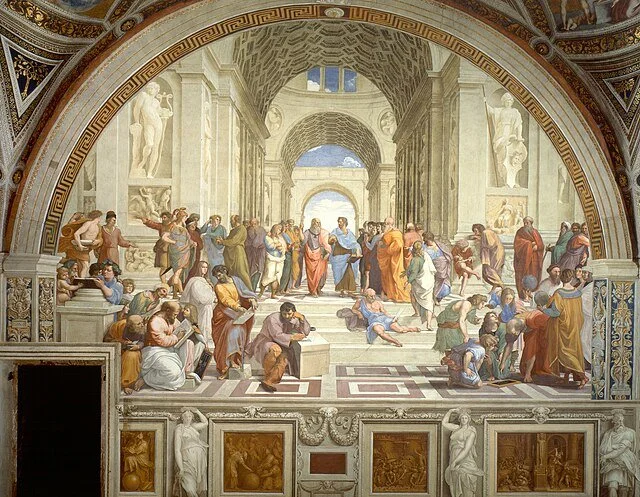
Photo Credit: Raphael
“...tyranny, which by stealth and force takes away what belongs to others, both what is sacred and profane, private and public, not bit by bit, but all at once.”
- Plato, translated by Allan Bloom
In November of 2024, the United States elected President Donald Trump and Vice President J.D. Vance, both holding the highest positions of power in this country. Upon taking these positions, they began to bring about the demise of the democracy that the United States was built on. Just ten months in their positions, they have caused the longest government shutdown in US history and the violation of many civil rights and liberties, one of the most notable being the substantial rise in deportations and arrests for immigration status (with the majority being illegally enforced and inundated with racial profiling). Also, the executive cabinet managed to increase our debt, with it now being $36 trillion, meaning that the debt-to-GDP ratio is even more unsustainable according to analysis on America’s fiscal future. The government is also removing funding from fundamental government programs like SNAP, the Department of Education, and others. This ultimately won’t affect those in power, but it will substantially take away resources to the rest of the country. The American people are beginning to realize this, and even Trump’s main supporters, the Republicans, are starting to open their eyes and disapprove of President Trump’s leadership.
One year after his election, as of November 2025, Trump’s net approval was -18%, three percentages lower than his first term around this time; as compared to Biden’s net approval around this time in his term was -7%, and Obama’s was 7%. In Trump’s Net Approval, around 58% disapprove, 39% approve, and 4% are not sure. This just goes to show that half of Americans are disapproving of Trump; no president, according to the Economist, has lost the country’s approval this quickly in all of history. Additionally, around 7 million+ people attended a No Kings Protest throughout all 50 states and internationally, including the following countries: Australia, Austria, Canada, Denmark, England, France, Germany, Iceland, Ireland, Italy, Mexico, Panama, Portugal, Spain, Sweden, Switzerland, the British Virgin Islands, and the Netherlands. They all protested Trump's application of kingly power over society.
The main focus point of these national and international protests doubling down in preventing the government from segwaying into elitism over the people. President Trump and his executive team are abusing power by attacking his own constituents and sending military troops with federal agents to our nearby communities to continue to terrorize the people he represents.
As much as he hates certain groups of Americans and constantly targets them, President Trump ironically represents them in office, and we the people are coming to a conclusion that he cares only about himself and the power he holds. Plato, regarded as the founder of Western philosophy, defined a tyrant as one that “[stirs] up war,” which is consistent with how the current government is causing clashes between Republicans and Democrats and one that “[takes away what belongs to others,” which is also consistent with President Trump's threats of taking away resources from universities who don’t agree to his agenda, as well as taking away free speech by targeting journalists and talk show hosts who criticize his leadership. In the continuous paragraphs, the Republic of Plato translated by Allan Bloom recognizes the signs of a tyrant, and how throughout history, including today, we are seeing the signs come to life.
Tyrannical Resemblances
One of the tactics that Trump fed into during his campaign was using his charisma as a rhetorical “trick” to convince the public of his goal to “[end] inflation,” in order to “make America affordable again.” This appeals to the general public because it emotionally moves them, giving them a boost of hope that our economy will be better. But something to note is that someone charismatic using rhetorical tricks to convince the people that there will be a future improvement, despite evidence to the contrary, engages in an eristic use of persuasion; this means that they are not using logos—using facts, statistics, and other evidence to appeal to the audience’s sense of reason and logic—and therefore shouldn’t be trusted, as those who should know better ultimately don’t.
Did Trump win? Yes. Has he improved the economy? Nope. Sound familiar? Let’s go back to the late 1920s. In Germany, their economy suffered greatly after the Wall Street Crash of 1929: “wages fell by 19% from 1929 to 1932,” and full-time employment dropped from twenty million to eleven million in four years, with ten thousand businesses closing every year—resulting in great poverty for Germany. The people began to distrust the Weimar democracy (the politics Germany was living under) and they wanted a change. Hitler and the Nazis saw this as an opportunity to use their propaganda to rise to power and thus, Germans believed that authoritarian rule was the only way to have a stable future for Germany that would protect their power and money. The Nazi Party gained Germany's trust through rhetoric that claimed to salvage them from their struggles; the party’s slogan “Work and Bread” promoted the party’s potential to create more jobs (unemployment being one of the biggest issues in Germany.) We see that obviously, this was not the case, and unfortunately led to a disastrous part of history.
In the Republic of Plato, Plato himself speaks on this tactic that was used by sophists: instructors that were vital in his time period to defend oneself in an Athenian jury. Sophists were instructors of rhetoric that taught persuasive skills through trickery; they valued winning through manipulation instead of the truth. In Athens, where Plato lived, they had large citizen juries that ranged from 200-2,500 people; sophists were thus important because in juries one wants to defend themselves against the highest charges in court and the assembly. In Plato’s Republic, he emaculates a visual representation of what a sophist-politician looks like when he leads, that being someone who believes they are “rivals in art” but “educates” only in the “convictions” of manipulation and trickery and then goes on to “call this wisdom.” Visually, Plato states that this is like a man who “learns by heart the angers and desires of a great, strong beast he is rearing.” This we can see resembles Trump and Hitler, both power-hungery and using manipulation to trick the public that they know what they are doing by first observing the frustrations of the beast, (the beast being the people,) in order to give the people glances of hope so they can hand the tyrants power. Plato then goes on to refer to such a man as “[corrupting]” the “best nature,” also known as the good or the true forms that are absolute (i.e., knowledge, justice.) This is someone who will ultimately, in Plato’s eyes, cause the “greatest harm to cities and private men.”
We can see this harm in modern times when one of the first and major promises that Trump made on his first day in office would be using the National Guard and empowering domestic police forces in order to get “the largest mass deportation program in history.” He promised to reinstitute the “remain in Mexico” policy, where this policy appears as if he has selected one group of individuals and decided he wants to remove them from the United States: reflecting it as a “remain in your country” policy towards Mexicans. Due to the influence that this policy has on the Trump Administration, Trump is targeting people who look Hispanic/Latino, and requires them to carry registration documentation at all times, with those who don’t carry them being questioned by I.C.E., a federal law enforcement agency, and facing potential fines, jail time, familial separation, illegal searches, and incarceration in detention facilities that are “private” and “profit-driven.”
This is in a way similar to Nazi Germany in 1938 where Jews were forced to carry special ID cards, and Jews adopted additional names to appear less Jewish and have a lower risk of being targeted. Going back to 380-375 B.C., influential philosophers such as Plato recognized the signs of the rising sophist-politians, or modern-day tyrants, those who “deny [they’re] a tyrant” but “grant freedom from debts and distribute land to the people and those around himself,” pretending to “be gracious and gentle to all.” Authoritarian style-leaders like Trump and Hitler thus are insensible to the truth of the actual good for a city but instead contribute to harming the state of the social order when they should be following the intrinsic good.
Demise of Our Democracy
Plato, in the Republic, continues to dismiss the tyrant as someone who is “filled with much slavery and illiberality, and although a tyrannic city is enslaved by a tyrannic monster, the true “depraved and maddest” soul in the city is the tyrant, who is driven by desires, or one can say power and money, and can never escape their corrupted soul that is stuck in a cycle that continuously reaches out to its thirsts. But Plato does point out that someone who has a tyrannical soul and ends up going into politics has to be the worst, as this tyrannical man is not only “rich in city,” but “ruling many,” and the power handed to them to rule in the world of politics makes the "multitude of the tyrant” ultimately “greater.” This is why democracy falls into a demise once it is in the hands of a tyrant.
Like an addiction, tyrants dig for more, they want their endless desires to be satisfied; they get money, power, connections, but it’s not enough. The tyrannical soul is mortifying, one that screeches in enslavement and digs for a final breath of satisfaction, but their desires are so uncontrollable that they are unable to moderate them, which leads to them becoming authoritarian amongst others. Now that the American people have to face the consequences of Trump’s inability to control his desires for power, that thus leaves carelessness for his constituents, we as a society have to start differentiating between those who are going into high political positions just for power and those who truly want to lead and help our people. That is the only way we can stop another tyrant from trying to take control of us and running our government for their own pleasures.
The question we should collectively ask ourselves is if we really want to give another tyrannical soul, one that yearns for unnecessary desires, “by some misfortune,” as Plato would say, “the occasion” to become a tyrant that could govern our society once again?