
This Country Was Founded on the Promise of Federalism. Has California Upheld This Promise?
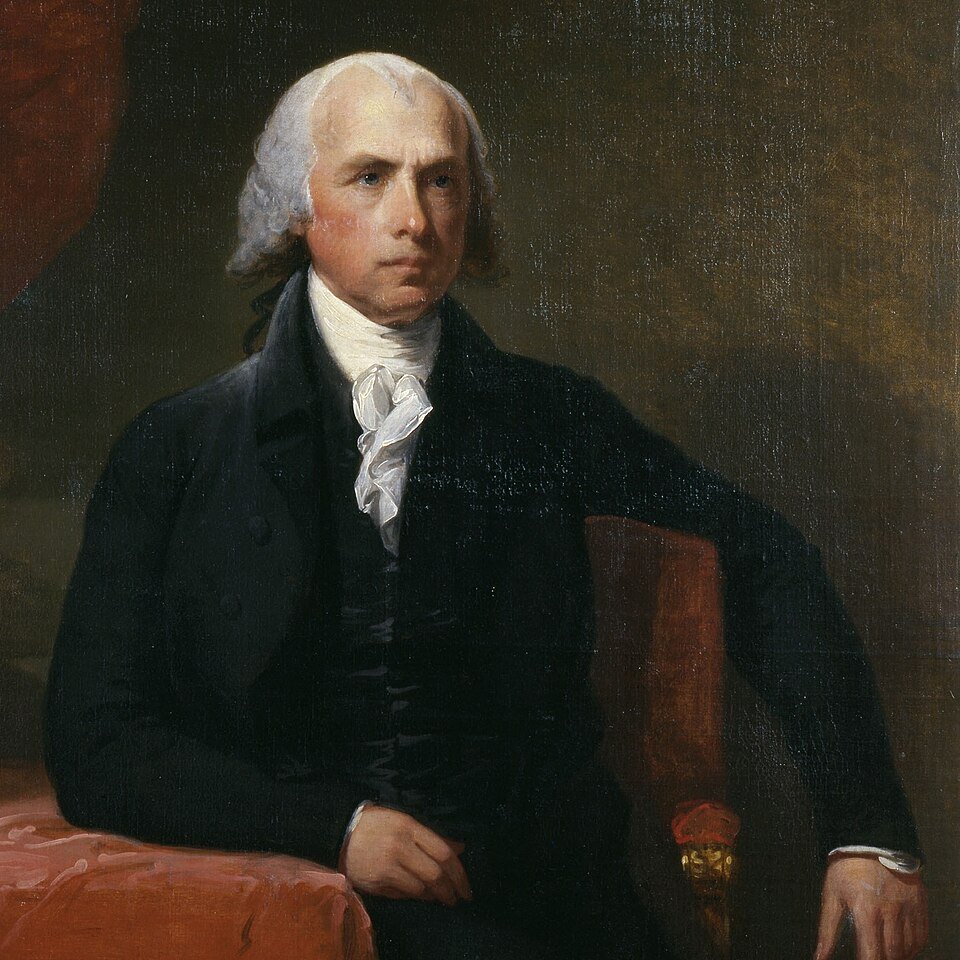
Art Credit: Gilbert Stuart
In 1788, in a bid to get the American populace to ratify a newly drafted Constitution, future President James Madison addressed the fledgling nation directly in Federalist 45. Under this new Constitution, he said, the “violent and oppressive factions which embitter the blessings of liberty,” that had ravaged the nation for decades, would be no more. Despite the more powerful central government threatening usurpation of the people's innate rights, the states were reserved powers extending to all matters of life, liberty, order, and prosperity. They would have the right to fight tyranny if it resurfaced.
This was the promise of federalism given by Madison to a people traumatized by the executive tyranny of the English monarchy. A promise codified into law by the Tenth Amendment, giving states the right, and thus the obligation, to use any power not granted to the federal government to resist despotism.
We are in an era of unprecedented federal tyranny. Under Trump’s leadership, economic stability, separation of powers, and fundamental constitutional rights are all under threat. Under the Tenth Amendment, the sovereign states of the US have a duty to protect citizens from these dangers. It is time for them to uphold the promise.
California in particular has been a historic bulwark for American rights and economic stability. For example, it dedicated $40 million to anti-Trump lawsuits during his first term and amended its Constitution in 1972 to amplify privacy protections as the federal government used emerging technology to bypass Fourth Amendment rights. Thus far, however, California’s efforts to defend its citizens against the encroachments of this executive branch have fallen short of its promise. There are many lessons California can learn from other states to better preserve our rights and freedoms from federal impingement.
To its credit, California has employed numerous successful anti-Trump policies. Through budget proposals and executive orders, Trump increased ICE’s (Immigration and Customs Enforcement) budget by tens of billions and increased their average daily arrests tenfold from 2024 to 2025. In California, this has led to nearly 1600 deportations of California residents per month, many of whom are denied trials by immigration judges (at the request of ICE) and held in unsanitary or dangerous ICE facilities.
Through sanctuary state laws, California confers significant power to local officials for immigration, allowing them to cooperate minimally with federal requests for extended custody and citizens’ immigration status. A series of bills passed in September 2025 additionally limits where federal agents can conduct immigration business without warrants and requires campuses to notify students when federal immigration agents are present. Further, on January 20, 2026, invoking obscure federal immigration laws, California Senators conducted an inspection of an ICE facility in California City. They uncovered inadequate medical care, contaminated provisions, and general prison-like conditions for detainees with only civil offenses.
Since directly impeding federal agents is outside the bounds of the law, these initiatives that improve community awareness and enforce legal checks on federal work are some of the best measures to combat unrestrained agencies like ICE.
California has gone further, dedicating $50 million to combatting Trump in court. Trump blatantly subverted the Constitution by trying to unilaterally end the 14th Amendment's guarantee of birthright citizenship. He usurped Congressional authority by freezing billions in legally appropriated funds for schools, transportation, families, and nutrition assistance, and used emergency powers designated by Congress under false pretenses to enact destabilizing tariffs. Presently the administration terrorizes American citizens by deploying armed forces to cities with political agendas opposed to Trump’s. California Attorney General Rob Bonta has used the state’s court funds to sue or join lawsuits against the Trump administration, securing injunctions, funding, or judicial review for all of those issues. These multi-state coalitions have even stopped the former Department of Government Efficiency (DOGE) from accessing the sensitive financial information of millions of Americans.
They have proven useful in non-legal settings too, as California has pooled resources with various states to combat federal anti-vaccine rhetoric and funding restrictions, and joined the WHO after Trump withdrew US membership. Using a ballot proposition that bypassed the state legislature, California also swiftly implemented emergency redistricting after Trump demanded Texas engage in partisan redistricting to inflate the number of Republican house seats.
Despite these successes, California’s grand flourishes of resistance have, in sweeping over the state, failed to address the less visible impacts of the Trump administration. While California has adequately fought many unconstitutional and coercive Trump policies, it seems like California has forgotten Trump’s damaging yet constitutional initiatives regarding the average worker and consumer. It is here where the holes in California’s promise to its citizens are obvious, and it should look to other states for examples of how to realize the principles this nation was built on.
First, California’s work protecting immigrants should be extended. California’s immigrant protections only regulate local government workers or ban federal immigration agents without warrants from protected areas, like schools. Both Maryland and Illinois have pending laws that would carry these protections to the private sector. The American Civil Liberties Union additionally recommends limiting tech companies in particular from sharing undocumented immigrants’ information with authorities. To enforce this, states have the power to expand Constitutional protections within state constitutions. California is one of few states that can put constitutional amendments up for a direct vote on its ballots. As such, it should put on the ballot constitutional amendments to limit employers’ and data brokers’ ability to give up immigration information.
With laws such as these in place, employers would be prohibited from disclosing the immigration status of their employees to federal authorities. While these laws often do not provide exceptions for authorities with warrants or knowledge of imminent harm, simple adjustments could protect private workers from arbitrary federal searches based on factors like apparent ethnicity or place of employment.
These laws are an effective step forward, but there are additional threats to workers California can address. Trump’s action regarding federal workers has massively disrupted the executive branch. Along with laying off nearly 300,000 federal workers in his first year, Trump issued an executive order stripping nearly 1 million federal workers of union protections, which also canceled collective bargaining for hundreds of thousands more.
At a time when national policy is hostile to unions, California must offer a sanctuary to fulfill its promise of offering respite from tyranny within its borders. In 2023 and 2024, California failed to pass measures that would provide unemployment benefits to workers on strike for longer than two weeks. Since then, seven states have proposed similar laws. California ought to put this initiative, and all other proposals trapped in the committees of our encumbered legislature, directly on the ballot so citizens can bypass gridlocked barriers to the rights guaranteed to them by their state. Without laws like these, federal workers lack the resources to unionize, negotiate, strike, and defend their rights. With no power to protect themselves, they are vulnerable to random termination.
Trump’s unilateral economic actions also threaten millions of small business owners and ordinary consumers. Trump’s immigration raids and abrupt tariffs have increased input prices, supply chain shortages, and investment uncertainty, which have cost businesses tens of millions. Local governments usually help with small business grants, but California counties are struggling as Trump cuts relief funds. Trump also tried to halt numerous federal loans and grants for small businesses. Although this measure failed, uncertainty and panic have contributed to investment reduction and revenue loss.
7.5 million Californians, and 99.8% of the state’s businesses now struggle with financial uncertainty. Other states are directly offering aid to citizens affected by these reckless national policies. Immediately after Trump’s election, Massachusetts authorized millions in targeted grants for small businesses involved in climate sciences Trump cut funding for. In November 2025, Illinois set aside $10 million in need-based grants for businesses negatively affected by the Trump administration. Also in November 2025, in addition to $14 million in grants, North Carolina provided infrastructure funding to help boost small business revenue. If California continues to idle as citizens struggle under Trump’s economy, the availability of basic commodities will be at stake.
A common concern with such measures is that, while they may be politically and economically feasible in other states, their struggles and available economic resources may be greater than California’s. In particular, California faces a $2.9 billion budget deficit, which makes resistance efforts more financially difficult than they may be elsewhere.
However, given that California has the largest economy and largest number of workers in the US, Trump’s union busting, layoffs, and economic destabilization affect California more than any other state. The budget deficit is also not a sufficient warrant to remain passive during this threat. Of the nine states referenced above that are dedicating significant resources to combatting Trump policies, eight have their own deficits; New York, one of the most active anti-Trump states, has the most debt per capita in the nation. California has faced a budget deficit since 2023, yet has increased spending for the past two years. If California can navigate spending more despite losing money, it can use a little more of it to combat the greatest executive threat the state has seen this century.
These are significant challenges, and it will take a monumental effort to protect California. But a state’s federalistic promise extends beyond budgets. When Madison wrote Federalist 45, he likely didn’t imagine states resisting tyranny while in places of privilege. He probably imagined states like the US in 1776, which was in debt, embargoed, and under invasion. The Tenth Amendment is specifically for indebted and struggling states, because they need some protected rights when national despotism deprives them of everything else. At this moment, when California still has the resources to fight and the leverage to do it, there’s no excuse not to fulfill its time-honored promise to its citizens.