
The Myanmar Civil War: The Consequence of Power
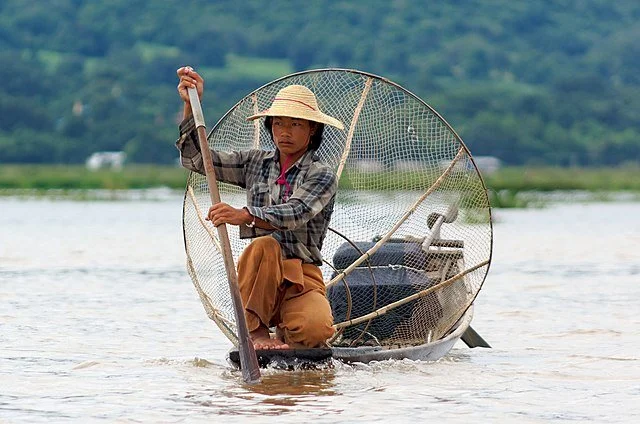
Photo Credit: Jakub Halun
Westwards of mainland Southeast Asia, at the crossroads of several civilizations, lies a country in the midst of a devastating civil war. Myanmar is a developing country, home to approximately 53 million people, and currently embroiled in a multisided conflict stemming from deep-seated ethnoreligious tensions and authoritarian military repression. The war is not a sudden eruption, but a culmination of deep political fractures: an overtly authoritarian government, an unfair balance of political power between the ethnic Bamar majority and ethnic minorities, as well as tensions between these groups. It is visibly leading to widespread human suffering, mass displacement, and regional destabilization, in spite of a lack of global media publicity. As of this year, more than 3.5 million people have been internally displaced, several hundred thousand have become refugees, and more than 82,000 total casualties have been incurred as a result of this war. Yet its significance also lies in the historical circumstances that allowed it to occur, and the successive set of choices made by this country’s leaders that led to this fiery path. This civil war, like many others bearing similarity to it in the world, illustrates the enduring structural weakness of post-colonial states in dealing with the challenges of political balance and ethnoreligious diversity. Where did it all go wrong? And more importantly, what solutions can be properly developed in the hopes of saving this struggling state and its people?
HISTORICAL BACKGROUND
The region of Myanmar is highly multiethnic and multireligious, encompassing a vast swath of diverse peoples. There are 135 recognized ethnic groups, the largest group being the Bamar, constituting about 68% to 70% of Myanmar’s population, followed by ethnic minorities such as the Shan, Karen, Rakhine, and many others. Buddhism has dominated Myanmar’s religious landscape for more than a millennia, and currently comprises 88% to 89% of Myanmar’s population. However, small Christian, Muslim, and Hindu minorities coexist alongside it. The heterogeneity in Myanmar is primarily due to its crossroad location between China, India, and the rest of Southeast Asia, as well as its mountainous terrain and dense jungles that make conventional travelling in this region difficult.
The modern state of Myanmar, formerly “Burma,” is the product of the British Empire’s successive annexations of the former Third Burmese Empire. The political boundaries today were demarcated out of the old empire’s borders with partial British reorganization. The colonial era, which lasted from 1824 to 1948, saw the deposition of the Burmese monarchy and the separation of religion and state. It also brought about unequal economic development that disenfranchised the Burmese peoples. More interestingly, the strategy of “divide and rule” was employed by the British, where they would give varied preferential treatment to certain ethnic groups over others, exacerbating pre-existing divisions in Myanmar’s society and bolstering each groups’ sense of self-identification and nationalism.
In 1948, Myanmar gained independence from the British Empire, with its first form of post-colonial governance to be a parliamentary republic. However, several misfortunes befell it. The main architect of Myanmar’s independence and driver of federalism, Aung San, was assassinated in 1947. Due to his death, the promise of a federal system in Myanmar was unfulfilled. His successors ultimately implemented a de-facto centralized government that unilaterally represented Bamar interests. In addition, ethnic minority separatists, betrayed by the lack of a sufficient federal system, waged prolonged guerilla warfare against the government in order to get full independence. Communist insurgents, who sought revolution and a full-fledged communist dictatorship rather than a democracy with socialist ideals, concurrently waged war with the central government. The unstable young country, overburdened by simultaneous crises and suffering from administrative undercapacity inherited from its inadequate colonial institutions, was unable to withstand the pressure and devolved into a military junta.
The Tatmadaw, the official name of Myanmar's armed forces under General Ne Win, initiated a military coup in 1962. This set the country on a path of isolated military rule and socialist policies known as the "Burmese Way to Socialism". He turned the latent parliamentary democracy into a firmly unitary and one-party socialist state, and attacked ethnic minorities through an aggressive policy of forced assimilation. Ne Win feared that a parliamentary federal system for Myanmar would provide them too much autonomy and break away from Myanmar, and believed that "Burmanization", or the process of assimilating non-Bamar people into becoming Bamar, was the key to long-term stability. Thus, the Tatmadaw ruled with an iron fist, as it perpetrated indiscriminate violence against dissenting citizens and perceived unruly separatists, and suppressed the languages and cultural expressions of ethnic minorities. In addition, he implemented isolationist policies such as autarky and aggressive nationalization of privately owned businesses, thereby separating it from the world market and handicapping its own economic development vis-a-vis its neighbors. By 1988, the country was on the cusp of revolution due to political repression and being one of the poorest countries in Asia. The “8888 Uprising” was an explosion of large protests, led by millions of students and workers against the regime. However, they were suppressed by the military, which declared martial law and subsequently killed thousands of unarmed protestors. In an effort to legitimize itself in the eyes of the people and the international community, the military allowed for general elections to be “held”. But conversely, it prevented the legislature from assembling, and even kept key democratic leaders imprisoned. The outcome of Myanmar’s 1990 election, which saw the democratic opposition overwhelmingly win despite electoral restrictions, was essentially ignored – a facade of democracy that served to legitimize military rule only when it was convenient. It then established a new military junta, reclaiming its iron grip on Myanmar.
Citizens fought back in the Saffron Revolution of 2007, where large protests were instigated due to the junta removing subsidies on fuel. The skyrocketing cost of living, coupled with the people’s grievances over the junta’s political repression, human rights abuses, and economic mismanagement, led to tens of thousands of people protesting against the regime. The publicized repression of these protests caught the attention of the international community, which placed new sanctions on Myanmar until it gradually reformed. The sanctions did not collapse the regime, but significantly pressured it to release political controls and allow for a partial democratic process to take hold. In the rewritten 2008 constitution, the state’s military accepted a political power-sharing agreement with democratic political groups. It was drafted that the Tatmadaw would retain 25% of seats in both chambers of Myanmar's bicameral legislature, keep independence from the civilian government regarding the national security domain, have one of the two vice presidents be appointed by the military, and a written “coup clause” that allows the president to declare a state of emergency and transfer power back to the military at any point in time. In exchange, democratic parties could run for elections and operate a civilian government.
In 2015, the new elections allowed by the junta forwarded the rise of the National League for Democracy (NLD) led by Aung San Suu Kyi, the youngest daughter of the late Aung San. The political opposition, for the first time in around two decades, was allowed to function properly, albeit limitedly. The reforms it implemented included the freeing of thousands of political prisoners, peacemaking and dialogue with Myanmar's insurgent organizations, and economic liberalization. However, Aung’s attempted reforms were insufficient to fix Myanmar’s nationwide problems. The core issue was that the military still retained large amounts of preeminence in the country’s political system due to the skewed terms of the 2008 constitution. This would constrain Aung’s ability to reform Myanmar. A highlighted example of this constraint was her inaction in stopping the military from the ethnic cleansing of the Rohingya according to international humanitarian organizations. To clarify, the Rohingya are a persecuted Muslim ethnic group living in an administrative division called Rakhine State, located in Southwestern Myanmar. Often referred to by the junta and extremist Buddhist groups as non-natives due to their different religious and ethnic characteristics compared to that of other Myanmar peoples, they are the largest stateless populations in the world due to a 1982 Myanmar law that explicitly excluded them from citizenship. In 2017, more than half a million were expelled and forced to take refuge in Bangladesh and other countries, and by 2023, more than 1 million were displaced. Their villages were systematically destroyed by the military, facing egregious human rights violations in the process. The lack of action by Aung San Suu Kyi in restraining the military’s actions, and even defending them in front of the International Criminal Court in 2019, destroyed her credibility as a human rights activist and democratic reformer in the eyes of the international community. Yet, the constraints placed upon would mean that if she did attempt to stop the military, she would risk her own political existence. Aung’s position in government, which was not the presidency, but an equivalent “State Counselor” status, could be retracted at the military’s will if it deemed she was too much of a threat. And indeed, this possibility of democratic backsliding would be validated five years later.
THE 2021 MYANMAR CIVIL WAR
The military rejected the outcome of Myanmar’s 2020 election, which saw significantly large gains to the National League for Democracy (NLD), as it feared that the NLD would implement constitutional amendments that would gradually reduce the minimum number of seats saved for the military and decrease its emergency powers. Headed by General Min Aung Hlaing, the Tatmadaw forcefully instigated a coup against the civilian government in February 2021. The military cited “unresolved electoral irregularities” as its justification. It subsequently detained Aung San Suu Kyi and other important politicians, dissolved the civilian government, and reinstated the military junta. Peaceful protests rose against the coup, only to be once again met with brutal repression. A coalition of these disaffected protestors, shelved pro-democracy officials, and ethnic militia groups, formed to oppose the junta and resurrect democracy in Myanmar. This coalition, The National Unity Government (NUG), has been the main opposition since the start of the civil war.
However, this patchwork of rebels only acts as a partially united front. Many of the ethnic armed organizations fight for their own ethnonationalist aspirations rather than for Myanmar as a whole. Though much of the opposition believes in the establishment of a federal parliamentary government, there are no clear steps that clarify how this establishment shall come to pass. It does not possess an articulate vision for the future of Myanmar, and what its government would specifically look like if they win, as many of its constituent ethnic organizations disagree on how much political autonomy they should have. The NUG itself faces a rolling path of disunity, as rebel organizations like the Kachin Independence Army disassociated itself from it as early as 2022. The coalition has also shown signs of coordination failure, as it could not collectively decide when and where to stop fighting. This is shown through several of the aligned ethnic organizations continuing military engagements with the junta despite Myanmar being recently devastated by the March 28 earthquake.
To complicate matters further, some of the ethnic armed organizations, instead of siding with the NUG, have gone their own paths, carving quasi-fiefdoms and rump states with minimal regard to the idea of "Myanmar" as a country. More recent reports show human rights abuses and authoritarian repression being committed by these rebel organizations, especially against the Rohingya. These rebel organizations also fight each other for control over territory, trade hubs, natural resource extraction sites, and ethnic aspirations. An example of this is the Chinland Council and the Chin Brotherhood fighting over underlying tribal grievances (despite being from the same group of ethnicities) as well as political competition on who should represent the Chin people, on top of both fighting the junta. The Tatmadaw also employs the tactics of “divide and conquer” by providing modern weaponry to some of these more independent rebel organizations, ensuring that they have the means to continue infighting.
The international response has been subpar. The Association of Southeast Asian Nations (ASEAN) is a regional international organization in Southeast Asia, and its core objective is to promote diplomatic and economic cooperation between member states like Myanmar. However, the conflict strains the Association’s most fundamental characteristics by asking uncomfortable questions about the limits of international cooperation. Its structure of needing unanimous consensus and non-interference in member states’ internal affairs is an obstacle for resolving the civil war. For example, ASEAN has barred the junta from participating in high level meetings, and affirmed its commitment to dealing with the Myanmar crisis with its “Five-Point Consensus”, a peace plan in which the junta would be recognized by ASEAN as long as it ceases hostility and commits to dialogue with other factions under ASEAN oversight. However, the Association as a collective organization has not placed broad economic sanctions as not all members agree to do so, and it lacks military enforcement power to force it to comply. The junta, four years into the war, has not fulfilled any of the consensus’s key steps, instead opting to curry favor with other major powers such as Russia and China to bypass ASEAN recognition. The Association has been urged by international organizations such as the UN to not to give acceptance of Myanmar’s most recently incoming elections by sending election observers, as they claim that Myanmar is too devastated and the military too distortive of open electoral processes. Yet some of its members are open to the idea of sending their own independent ones, undermining ASEAN’s consensus-based decisions.
China is also the most active geopolitical player in the conflict. This is due to the rare-earth mines near the Myanmar-China border areas, and the Sino-Myanmar oil and gas pipelines that extend from Kyaukphyu to Kunming, all of which are major Chinese investments in the region. In addition, it desires the elimination of the illegal drug trade, scam centers, and transnational human trafficking programs operating within Myanmar that have harmed thousands of people and sucked billions of dollars out of China’s and Asia’s economy. In order to achieve this, however, it supports both the junta and rebels to maintain the balance of power between them. This major power lodges itself as a power broker and negotiator between the factions, not to end the civil war necessarily, but to ensure that such Myanmar does not undergo a complete state failure and destabilize the rest of Asia. As of now, China supports the junta through military aid and drone technology because it wants the Sino-Myanmar pipelines, most of which is in junta-controlled territory, to remain protected. It concurrently employs diplomatic pressure on the rebels to stop them from attacking the junta and risking damage to Chinese investments. Yet China also supports some of the rebels like the United Wa State Army because they are more immediate neighbors of China that possess economic and strategic value. In 2023, it previously and tacitly backed a rebel-coordinated attack against the junta in order to curb organized cybercrime and destroy the scam centers the junta was incapable of demolishing. Only after this group of rebels, called the “Three Brotherhood Alliance”, gained too much territory, did China begin supporting the junta again out of fear in Myanmar’s fragmentation. Conflict analysis organizations claim that supporting the junta and rebels in this manner only prolongs the civil war, as their expectations of complete victory without a ceasefire or compromise are raised knowing that external backers will come to their assistance.
IMPLICATIONS AND SOLUTIONS
Myanmar’s instability is driven by a failure to manage its own societal heterogeneity, as well as its military leadership’s unwillingness to commit to democratic dialogue and a peaceful transition of power. It is important to note that it is the presence of ethnic and religious diversity within a state that does not inherently cause state failure. Rather, it is the strength and design of the institutions meant to handle this diversity properly. Almost all of Myanmar’s post-colonial history since independence involves militant insurgencies, outwardly hostile policies against political dissenters and ethnic minorities, and tendency towards authoritarian military rule. Worst of all, these things reinforce each other to a point that complex, multipronged solutions are needed to deal with all of these issues simultaneously, on top of other governing responsibilities such managing the economy and social welfare. Whatever helpful institutions and policies that could have developed within its historic time frame are next to non-existent.
Myanmar shows us the consequences of abusing state power, and how past decisions made by misaligned leaders can create a cascade of consequences for those in the future. Myanmar’s failure to implement federalism for its ethnic minorities was due to Aung San, the key architect of this idea, being assassinated before Myanmar’s independence and before his plan could be implemented. The junta’s chokehold on the country today was only possible due to Ne Win’s decision to overthrow the democratic government in 1962, and subsequent repression in the decades that followed it. Previous revolts sowed the seeds of future revolts, as the overuse of violence in the achievement of state goals only furthers resentment and grievances in the minds of the repressed. The 2021 Civil War would not have happened if it weren’t for the Saffron Revolution, which would not have happened if it weren’t for the 8888 Uprising. The ethnonationalist ideologies of the ethnic armed organizations stems from the failure of the government to hear the voices of their smallest communities, and their own forceful implementation of ethnic assimilation in a bid to create a perfect society. The ethnic cleansing of the Rohingya occurred because of accrued authoritarian power as well as ethnoreligious animus stemming from preferential treatment during the colonial era. But there may be two paths Myanmar can take to stabilize its political system and prevent future conflict:
Emergent Federalism – This is a “bottom-up” implementation of federalism by the Bamar opposition and ethnic minority organizations. Emergent federalism is a consistent back-and-forth process where constituent units of a constructed federal government dictate the terms and systems of such government rather than the other way around. In order to do this, there must be clear and concise communication between the NUG, its affiliated ethnic organizations, and even outside ethnic organizations not in the coalition. Clearer visions of a federal government that ensures states’ rights and built up by the constituents themselves will surely make these organizations more interested in unifying the rebel front, and hopefully less interested in tearing up their own agreements.
Confederalism – Rather than establish a federal system, which entails a moderately strong central government, Myanmar can decentralize further and start from scratch. If confederalism is established, arguments and debates over the role and power of the central government would be less important, as confederacy essentially guarantees state autonomy in the economy, military, and other important government responsibilities usually for central governments. In effect, each organization that joins in a confederation does not have to relinquish much sovereignty to participate, possibly expanding the NUG’s pool of allies compared to a federal system. If winning the civil war and eliminating the junta is the #1 goal, then a “Confederacy of Myanmar” may be the quickest and best way of getting as much support from Myanmar’s disparate groups as possible.
Even now, as Myanmar continues to fall into chaos, the international community has failed to take the proper actions to encourage peace and prevent human rights violations, either due to a fear of commitment or the need for realpolitik. The failure of ASEAN to assert itself in one of its own constituent states, the double-dealings of China with the junta and rebels, the general lack of international cohesion, as well as the inaction of the West, India, and Russia only illustrate that we are capable of much more than what we are currently doing. There are three possible strategies that the international community can take to alleviate the suffering the war has caused:
Coordinated International Action – Myanmar's immediate neighbors, major powers, and the wider international community should coordinate an effort to recognize the NUG as a legitimate government of Myanmar. Trade and diplomatic relations solely with the junta only bolsters its reasoning that it is the sole legitimate government, and that the NUG is an illegal rival government. The idea is that countries that wish to continue to recognize the junta as a legitimate government should be able to do so, but should be encouraged to recognize NUG as a counterweight. For example, China supports and formally recognizes the junta only, but has worked with rebels and the NUG, stopping short of recognizing the latter. China only supports the junta due to the perceived immediate stability and security it can bring. If it can be argued that the junta’s faulty framework of centralized dictatorial rule will only bring about future ethnoreligious grievances and conflicts that China has to manage by its borders, perhaps it can be argued that also recognizing the NUG is a step towards long-term federal stability. This may force the junta to accept a power distribution structure, otherwise it may lose support as it appears intransigent to reform. This can be thought of as an expansion of China’s “stakeholder” balancing strategy, but oriented more in reducing future micromanagement. International efforts are multiplicative. If organizations and countries like ASEAN, China, India agree to work together towards a neutral and stable Myanmar under the lines of pragmatism and reducing the likelihood of instability across their region, recognizing the NUG and the potential it represents is a step towards that.
Non-State Engagement – The international community should extend humanitarian aid and outreach to the non-state actors in the civil war, such as the ethnic armed organizations and other rebels. This way, the junta’s control over aid distribution can be circumvented, and regions that do not have substantial access to aid regain it. The many parallel governments in Myanmar, represented by the various factions, have one thing in common: they do not want their population to suffer from starvation. At the same time, they’ll take all the help they can get. In this line of reasoning, aid in the form of policy advising or basic supplies should be given to the non-state actors, especially those that promote humanitarian state-building, in order to incentivize ethical and humanitarian conduct in warfare, while simultaneously helping needy populations.
Inclusive Ceasefire Agreement – Scholarly research on the analysis of Myanmar’s ceasefires show that non-inclusive ceasefires do not reduce a country’s overall level of violence. When some armed groups are excluded from peace talks, these groups often increase their hostility against the ruling government, as they have no off-ramp and genuinely believe that they will be targeted for destruction. This increase in hostility thus counteracts the peace gained from a partial ceasefire, negating the purpose of peace in the first place. To solve this, a ceasefire agreement in Myanmar must be cohesive and inclusive. This means that most if not all of the factions of the war must be included in the ceasefire process.
CONCLUSION
The Myanmar civil war continues to rage on. The despondent and chaotic free-for-all that illustrates its current status does not show signs of stopping. Anti-regime rebels made significant inroads into junta-controlled territory in the first years of the war due to non-compliance of the civilian population and the persistence of ethnic armed organizations. But now, the rebels’ wartime inertia falters as divergent factional interests and inappropriate international military support stall the conflict into a standstill. Someday, the civil war will end, the people of Myanmar may have a chance to rebuild and learn from past mistakes, and the potential solutions may ease tensions and help bring about a peaceful future. But this future must be fought for; it must be planned, negotiated, and complex if it is ever to be brought to reality. So, why not start now?