
The Last of the Americans: Historical Parallels Between the Fall of the Roman and American Republics
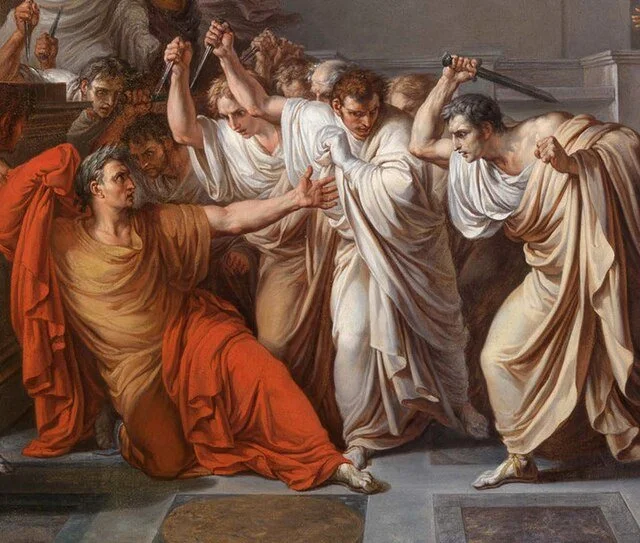
Photo Credit: Vincenzo Camuccini
Throughout human history, numerous republics have risen and fallen. Athens, Rome, Venice; the United States of America is not the first, nor will it be the last. Like any government, there will come a time when its institutions and foundations are so perverted that it can no longer be considered the same political entity. Rome experienced this transformation during classical antiquity over the course of many decades, culminating in the ascension of its first emperor, Augustus. Of course, that was some two thousand years ago; at first glance, one may wonder how such an ancient nation could be analogous to contemporary America, but upon further examination, it could be argued that the current state of our democracy parallels, or at least rhymes with the fall of the Roman Republic. As such, it is possible to study the lessons that it provides for history with its decline and transition into autocracy, such as how it happens, who may be to blame, and perhaps even when we can expect a potential collapse of our own democracy.
Before going further, it must be noted that parallels do not equate to exact replication. There are many differences between our modern country and that ancient republic, which serve as decisive factors in the dance between democracy and despotism. For instance, Rome was a supremely militaristic state, debatedly more so than the United States. There was little, if any, separation between politics and the military. In fact, it was required to serve in the army to initiate a political career. This allowed aspiring statesmen to engage in military campaigns as a means to gain vast wealth and popularity to promote their domestic ambitions. Figures such as Scipio Africanus, Gaius Julius Caesar, and Gnaeus Pompey Magnus exemplified this binary. Before the late republic, this integration was not an issue as loyalty to the state remained high, but this lack of segregation eventually led to extremely problematic outcomes. Pompey doubled the income of the Roman treasury (and made himself wildly rich) through his lengthy conquests of the eastern Mediterranean, which launched him into stardom and allowed for a highly successful political career. However, as allegiances to Rome diminished in the aftermath of the Third Punic War, some turned to military might if they could not achieve their political aims. Caesar utilized the loot his legions plundered from Gaul (modern France) to solidify their allegiance to him. Using his loyal legions, he infamously marched on Rome itself after a falling out with the Senate. The United States, on the other hand, has not suffered from this problem. While our nation boasts multiple noteworthy men who were both generals and politicians, such as George Washington, Ulysses S. Grant, and Dwight D. Eisenhower, the civilian government and military apparatus are largely kept distinct. Of course, the President serves as the Commander-in-Chief of all armed forces, but traditionally, he has delegated responsibilities to others to secure victory. As a result, our military is (ideally) loyal to our government, not any one individual.
Another key deviation can be found in the form of government that the two states can generally be described as. By the time of Julius Caesar, Rome had functioned as an aristocratic republic for centuries, meaning that a slew of powerful families dominated its politics. There were some checks and balances to ensure that the common people of the city held some sway, but ultimately, major families like the Fabii, Cornelii, and Claudii retained most of the wealth and political power throughout the long history of the republic. The United States is a trickier case to identify. It is most commonly identified as a constitutional republic, but for our almost two hundred and fifty year history, it has in practice operated as an oligarchy. It is certainly more democratic than when the constitution was implemented in 1789, but it cannot be overlooked that the majority of Americans have not practiced suffrage for most of this country’s lifespan. Initially, the vote was granted only to white, property-owning / tax-paying males (roughly 6% of the population). It would be over a century before women, African Americans, Native Americans, and other minorities were enfranchised. Although there remains a strong argument that the contemporary United States is far more democratic in nature than at our country’s founding, in recent years, a sense of cynicism regarding how our republic functions has begun to permeate our political culture. Some have begun to classify it as a “functional oligarchy” due to the disproportionate favoritism of the wealthy, corporations, and business groups over average citizens. This pessimism is additionally exacerbated by growing socioeconomic disparity. Despite this, the United States still exercises more political and social mobility than its ancient counterpart.
These are certainly significant differences, but there still remain enough similarities to maintain the comparison. The first appears with the development of internal politics in response to geopolitical events. Famously, Rome fought a series of three wars with its ancient rival, Carthage, for dominion over the Western Mediterranean. These were wars of existential proportions; the very survival of each state was at stake. Ultimately, Rome emerged triumphant and in 146 BCE razed the city of Carthage to the ground in what can be called one of the earliest instances of genocide. Ascending as the preeminent power in the ancient world, Rome went on to conquer essentially the whole of the Mediterranean within a century. However, what Romans did not realize was that, with the fall of what had been their greatest enemy, they had also lost that which unified them. Solidarity in the republic disintegrated quickly; within two decades violence between two developing political factions, the Optimates and Populares arose. The former bloc was composed primarily of the aristocracy, whereas the latter enjoyed support from the common people of Rome. Intense wealth inequality and poverty heightened tensions, and political rivalries turned deadly. The twentieth and early twenty first centuries have brought about a similar effect for the United States. During World War II, the German Reich and Japanese Empire served as our great unifiers, and after their defeat the Soviet Union (and the ideology of communism) became America’s existential enemy. Since the collapse of the Soviet Union in 1991, we have lacked a great unifying enemy. 9/11 and the subsequent War on Terror partially filled the vacuum, but it did not elicit the same response as national socialism, Japanese imperialism, or communism. The results have been reminiscent of Rome’s.
Hence, the United States has experienced a process of extreme political polarization in recent decades. While the divide can be traced back to the Cold War, 1991 saw the beginning of an increased rate of growth. Major events, such as the entry of Donald Trump into politics, his elections to the presidency in 2016 and 2024, as well as the COVID-19 Pandemic have served to exacerbate the issue. It is becoming increasingly clear that there is less common ground and less willingness to compromise between Democrats and Republicans (as evidenced by the fourty-three-day government shutdown, the longest in American history). Not unlike Rome, political violence is also becoming more common, or at least is perceived to be more common. Acts such as the 2022 attack of Paul Pelosi, the assassinations of Charlie Kirk, Mark and Melissa Hortman, and the attempted assassination of Donald Trump have all served to illustrate this unfortunate parallel. And of course, the January 6 Capitol Insurrection may be the most damning example. Within recent memory, an individual or group had never before so brazenly attempted to overturn a legal election using loyal supporters. The American Civil War was likely far more devastating and reverberating, but it seems that most Americans believed that the United States had outgrown such violent political division.
The Romans had similar idealistic thoughts that were shattered in the aftermath of the Third Punic War. In the 130s - 120s BCE, two brothers, Tiberius and Gaius Gracchus, emerged within the political sphere. By the time they were dead, the two had radically transformed it for the worse. Both of them found that they could not further their ambitions through traditional means, so using radical populist tactics, they brute-forced their way through politics. What aided their popularity was the intense wealth disparity and widespread poverty that the city of Rome faced during this time. During their respective forays in the Roman government, they consistently exercised a disrespect not only for long-enduring precedents but also for the law itself under the guise of the “will of the people”. In 133 BCE, Tiberius was elected to public office, and used his newfound power to introduce a controversial bill that proved to be extremely popular with the common people but was despised by the Senate, which was composed largely of the aristocracy. When a colleague by the name of Marcus Octavius repeatedly blocked his attempts to pass the proposal, Tiberius ordered his supporters to physically remove Octavius so it could be enacted. Importantly, Roman law specified that it was sacrilege to touch a plebeian tribune, which both Tiberius and Octavius were. This, in conjunction with other legal desecrations, culminated in Tiberius’ murder by political rivals the same year. A decade later, Gaius would follow in his older brother’s footsteps. Not only would he demonstrate the same disregard for law as Tiberius, but he would surpass him in his success. Rome mandated that one could only be elected as plebeian tribune once; it was Tiberius’ ambition to be elected to two consecutive terms to escape legal repercussions that resulted in his assassination. Gaius did just that, and it was his efforts to secure a third consecutive term that led to his death. Through bribery and political chicanery, Gaius’ enemies soundly defeated him. Understanding that he would likely be tried and killed for his own illegal actions, he committed suicide rather than be caught. One cannot understate the effects the Gracchi brothers had on the late Republic. For the first time, inter-ideological violence had been used to resolve disputes on both sides. The brothers were all too willing to use it to achieve their ends, and their enemies were all too willing to use it to destroy them. This ultimately set a precedent of violence as a means for political settlement, which would initiate the Republic down a dark path, one that would culminate in its downfall.
In recent years, the United States has undergone a comparably worrying process. While throughout our history there has been no shortage of men without respect for the law, notably during the Grant and Harding administrations, there seems to be a far more systematic breakdown of legal statutes and precedent than before. Gerrymandering, for example, has always been a chronic illness in American democracy. The name’s inspirator, Elbridge Gerry, was a founding father and signatory of the Declaration of Independence. However, 2019 saw the landmark Supreme Court case Rucho v. Common Cause, which ruled that issues with partisan gerrymandering were “inconsistent with democratic principles” but were beyond the reach of federal courts. After the 2020 census, the redistricting process for most states was controlled by Republicans, and the results were certainly undemocratic. Maps used during the 2024 elections showed a net average of sixteen fewer Democratic districts than those presented for the Freedom to Vote Act, which would have eliminated partisan gerrymandering. From there, it could only be a matter of time before this problem becomes endemic. Just earlier this year, the state of Texas (at the behest of President Donald Trump) redistricted its congressional map in order to gain upwards of five seats in the House of Representatives. In response, the controversial Proposition 50 in California was recently passed, indicating that the left, as well as the right, are receptive to anti-democratic processes as a means to gain a leg up over their opponents. Unfortunately, this will likely only lead to additional political retaliation from both sides.
What aggravates these problems further is the behavior of President Donald Trump throughout his tenure in American politics. Since he took office earlier this year, there have been repeated and continual attempts (successful and not) to subvert legal precedents and constitutional law. The list is staggering; over two hundred executive orders have been signed by Trump, with dozens being blocked by courts. This executive volume is likely part of a broader strategy to overwhelm political opponents with an inundation of legally dubious actions, as any that slip through may encourage additional onslaught. This whirlwind is not merely for show, as there are deep molestations of constitutional law, including violations of the First, Fourth, Fifth, and Fourteenth amendments, as well as countless other laws, including some found in the Bill of Rights. The message is clear: With every successful infringement of basic rights, the law becomes more perverted, which paves the way for more illegality. Particularly troubling is Trump’s refusal to rule out running for a third presidential term, which is expressly forbidden by the Twenty-Second Amendment. It would have to be repealed if he wished to press his luck as Gaius Gracchus did. Even then, as the latter fatally learned, success is not inevitable.
Of course, as the United States remembers what occurs when Donald Trump loses an election, the Romans were also painfully aware of what political disputes can do to overly ambitious and morally questionable individuals. A generation before Julius Caesar crossed the Rubicon, a general by the name of Lucius Cornelius Sulla marked history as the first man to march on the city of Rome with a force of six loyal legions in 88 BCE after a political rival, the famous in his own right Gaius Marius, took control of the city. Whereas the Gracchi brothers set a precedent of political violence, Sulla cleared the way for others to use military force to achieve their aims. This shift in mentality is evident in those who spiritually succeeded him. The aforementioned Gnaeus Pompey Magnus remarked, “If Sulla could, why can’t I?” Within sixty years, the Roman Republic lay in ruins, and its first emperor, Augustus, was ascendant.
But Trump’s own “march on Rome” failed. January 6 did not overturn the 2020 election results, and our democracy endured. Dishearteningly, he faced little in the way of repercussions and was reelected in 2024. So what does this indicate for our constitutional state? While the similarities between the Roman Republic and the United States are (hopefully) evident, the reelection of Trump has departed from the analogy. Sulla’s march on Rome was successful, as was Caesar’s. There was another attempted coup by a failed politician named Lucius Sergius Catilina in 63 BCE, but he was killed in battle against a Roman army. Suffice it to say, these are unprecedented times; what’s left for us is speculation.
However, one fact is without doubt: All governments fall. Be it republics or autocracies, no political entity endures infinitely. There will come a day when our sacred democracy is lost, and in its place something else entirely may sit. Yet for now, that is not a definitive conclusion. At the heart of all trends, historical, political, social, or otherwise, lie human beings who are capable of making conscious choices to be better. If enough politicians were to agree that the United States and the republic for which it stands are owed loyalty over any individual, then our great nation would be rejuvenated, and our democracy could continue to flourish. In an ideal world, this is not improbable, but there are many who would assert that such a change in mentality is naive and unlikely. If this is the case and our republic is doomed to fall, then, given the path that Rome traveled, it could be expected to happen no later than a century from now, and as early as within a decade. This does not mean that we must be pessimistic about the prospect of the death of American democracy; the end of the Roman Republic saw the beginning of the Pax Romana, a two-hundred-year golden age for the ancient state that saw widespread peace and increased prosperity. Also of note is that while history certainly offers the contemporary world valuable lessons, it cannot be extrapolated to predict the future with minute precision.
Ultimately, any government is only as virtuous as the individuals who inhabit it. Autocracy and democracy are merely political concepts that are inherently neither positive nor negative. Rather, it is the effectiveness of the countless statesmen, politicians, administrators, generals, admirals, aides, and professionals that influences opinion. And who knows, we may find ourselves lucky and in these hard times discover leaders of virtue and principle to drag the United States out of the abyss we seem to be slipping ever more into. The Romans enjoyed figures such as Cato the Younger or Marcus Junius Brutus, one of the conspirators who assassinated Julius Caesar in an attempt to preserve the Republic. During his life, he was dubbed the “Last of the Romans” by his eventual victim due to his embodiment of the old Roman spirit. What remains to be seen is if there will be any “Last of the Americans.”