
The Current and Potential Consequences of Trump’s Terrorist Label on Mexican Drug Cartels
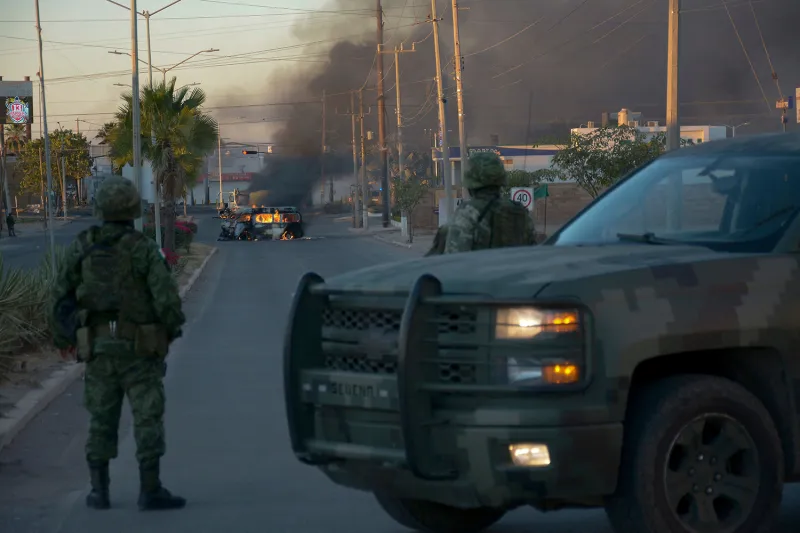
Photo Credit: Juan Carlos Cruz via Getty Images
On January 20th, upon the inauguration of his second term, President Trump issued several executive orders. One of those orders has significant resemblance to policies from previous administrations. Trump's proposal of “Designating Cartels And Other Organizations As Foreign Terrorist Organizations And Specially Designated Global Terrorists” is representative of President Reagan’s ‘War on Drugs’ and President Bush’s ‘War on Terror,’ two major policy campaigns that significantly expanded executive authority and encouraged the systematic oppression of the black and brown demographics.
This policy seeks to address the growing influence of narco-cartels in Latin America by using counterterrorism efforts to achieve the elimination of these organizations. The administration is framing drug-cartels as entities that go beyond organized crime, presenting this executive order as a measure designed to protect the national security of America. The classification of cartels as foreign terrorist organizations (FTOs) stems from their significant effect on global politics. Specifically, this order was presented to combat Mexican drug cartels, as they are leading the supply of various illicit narcotics to the United States. The U.S. government has spent more than $1 trillion on combating drug proliferation since the 1970s. However, these efforts have had limited impact, as Mexican cartels continue to have the most significant role in the drug trade, controlling all means of production, trafficking, and distribution of illegal drugs worldwide.
The order was pivotal to Trump’s 2024 campaign, as it was a direct response to the Biden administration's management of the southern border. The Trump administration criticized the former president for what they described as Biden’s “open border policy.” Trump characterized this border policy as an open invitation to violence, arguing that “the drug cartels and their allies in the Biden administration have the blood of countless millions on their hands. Millions and millions of families and people are being destroyed.” President Trump emphasized that there is an “attack” on the southern border, declaring, “the drug cartels are waging war on America—and it’s now time for America to wage war on the cartels.” His diplomatic approach has been aggressive, even threatening an invasion of Mexico and the use of military force against cartel operations.
The executive order has been in effect for 10 months, and there has been an intensification towards border policy. The prioritization and effectiveness of border security is aided by the 1798 Alien Enemies Act—which grants the executive authority to detain or remove non-citizens during times of war. Trump has put his border agenda into motion, promising “the largest deportation program of criminals in the history of America.” The administration's deportation procedure has been chaotic, and it has invoked fear in communities. Through Immigrant Custom Enforcement and the National Guard's aggressive tactics, 527,000 immigrants have been detained, including those with legal status inside churches, schools, hospitals and even immigration courts. The administration seeks to further its efforts by shutting down the borders, weakening asylum and refugee programs. Trump has also brought the resurgence of the Guantanamo Bay Detention Camp, preparing to hold 30,000 migrants in order to "detain the worst criminal illegal aliens threatening the American people.” This institution was first established by the Bush administration during the ‘War on Terror,’ and used as a location to detain and interrogate potential terrorists. The camp faced controversy and backlash, as Muslim individuals were being held for years without a charge or trial, while their human rights were consistently violated. The classification of cartels as an FTO contributes to the vilification of the Hispanic demographic, similar to how Muslim individuals were portrayed during the Bush administration. The destination grants the United States agencies such as the FBI, the National Counterterrorism Center, the Department of Justice, Immigration and Customs Enforcement (ICE), and the U.S. Treasury Department the power to combat FTOs. With such a wide range of tools available from surveillance to sanctions, the line between counterterrorist policy and radicalized targeting can be blurred. As the language used towards this issue invokes terms like “aliens” and “terrorism,” it produces a narrative that indirectly frames Hispanic migrants as outsiders who threaten the integrity of the nation.
The designation has also taken effect beyond state lines, as President Trump has signed a directive to the Pentagon to begin the steps of military intervention against Latin American Cartels. The administration has avoided Congress, as they are not bound to the War Powers Resolution or obliged to seek Congress’s permission to continue its anti-cartel campaign. This has resulted in U.S military operations at sea and foreign soil to combat drug trafficking, with a lack of congressional oversight on Trump's decision making. The combative approach taken towards drug trafficking has been demonstrated in the fatal attack by U.S. officials against suspected Venezuelan drug smuggling boats. A series of strikes caused the death of 21 individuals, whom the Trump administration has claimed had been linked to the Tren de Aragua gang. The attack has stirred controversy, as the strikes are being debated on their legitimacy. The Trump administration has failed to provide evidence to lawmakers that the boat's cargo in fact carried narcotics or that the passengers were gang affiliated.
Trump supporters have argued that the strikes were necessary as an act of self defense, banking on the consensus that the cartels are killing Americans through drug smuggling. United States Secretary of War, Pete Hegseth, doubled down on the attack, backing President Trump, stating, “our intelligence, without a doubt, confirmed that this vessel was trafficking narcotics, the people onboard were narco-terrorists, and they were operating on a known narco-trafficking transit route.” Secretary of State Marco Rubio also attempted to bring recurrence on their approach to the cartels and drug trafficking, stating “these drug trafficking organizations are a direct threat to the safety and security of the United States, to unleash violence and criminality on our streets, fueled by the drugs and the drug profits that they make.” This has raised questions about whether the administration will go to extreme lengths to desperately justify military presence in Latin America and Trump’s decision-making, as even Congress has been left largely in the dark. Congress has grown frustrated, which has forced lawmakers to attempt to pass a bill that would have granted greater oversight of Trump’s military strikes on drug-smuggling operations, which Senate Republicans voted the legislation down. Permitting the Trump administration to continue its efforts on narcotics without the authorization of Congress is a continuation of the expansive powers that undermine legislative authority. Bush's approach during the ‘War on Terror’ has permanently reframed the U.S government by enabling undemocratic behavior. Allowing for executive authority has led to the exercise of an unreasonable amount of power towards foreign policy, military decisions and political issues.
With urgency to respond immediately after September 11th terrorist attacks, Congress passed the Authorization for Use of Military Force (AUMF). This resolution has undermined Congress's authority over the military ever since. The AUMF granted Bush the power to expand executive authority in military operations and national security. This furthered military occupations in the Middle East, leading to invasions in Iraq and the hunting of those responsible for the deadliest terrorist attack in history. Like Trump, Bush was supported. The Secretary of Defense, Donald Rumsfeld, continued to look for justifications to invade Iraq and remove their merciless dictator, Saddam Hussein, from power immediately after September 11th. Deputy Secretary of Defense Paul Wolfowitz was infamous for his active support of the invasion. Vice President Dick Cheney advocated for the invasion of Iraq and continued to stand by his decision throughout the years. Trump’s portrayal of the cartels as waging “war” on the American public mirrors Bush’s justification of the accusation that Iraq held “weapons of mass destruction.”
The ‘War on Terror’ is an event that has not been looked back on favourably. U.S military invasions in foreign nations such as Vietnam, Iraq, and Afghanistan have resulted in failure and the ‘War on Cartels’ will follow the same route. The designation places these drug cartels alongside groups such as ISIS and Al Qaeda, which can be argued for. These groups are labeled as FTOs who spread terror both within and influence outside their state, but in spite of that, the objective is not the same. Drug cartels are a criminal organization that strictly want profit, not terrorists who seek political change. If Trump were to eliminate a specific cartel group, the outcome would not address the violence of cartels or reduce the demand for drugs. An invasion of a sovereign country like Mexico will negatively affect bilateral security cooperation agreements and economic relations. Mexico's president Claudia Sheinbaum responded to Trump’s threats of military intervention and accusations of aiding drug cartels stating, "this cannot be an opportunity for the U.S. to invade our sovereignty," and pointed out that,"if there is such an alliance anywhere, it is in the U.S. gun shops that sell high-powered weapons to these criminal groups.” This claim stems from the yearly estimate of 200,000 to half a million American firearms being smuggled to Mexico, building the expansion and influence of drug cartels. With the United States partly responsible for the growth of cartels, calling for an invasion is not only hypocritical, but would also create another U.S. conflict on foreign soil that would be deemed unnecessary.
The classification of any specific group as Foreign Terrorist Organizations results in the consequence of ‘material support,’ a clause that will potentially impact U.S. businesses, organizations and U.S. citizens. Material Support is a law that prohibits an individual or group to aid a designated foreign terrorist organization. Though the law seems clear cut, it is a broad law that impacts a wide range of actors. U.S. companies that operate in Mexico can unintentionally support drug cartels, since many Mexican businesses are either controlled by or affiliated with cartel networks. Organizations that provide services such as churches, synagogues, and food banks can also be considered as terrorist financiers. These organizations seek to help migrants; however, many of these individuals are smuggled in by cartels, as migrant transportation has become a major source of profit. This can hurt these organizations as their assets can be frozen and the migrants can receive an unfair prosecution.
Lastly, within state lines, Material Support will effectively incarcerate more U.S. citizens for drug-related offenses. Reminiscent of the shortcomings of former President Reagan’s ‘War on Drugs,’ low-level drug users or dealers are open to attain Material Support prosecution as Mexican Cartels control a large portion of the drug trade in the United States. Receiving a harder charge doesn’t solve the American drug crisis. Although first established by President Nixon, who declared drug abuse “public enemy number one” in the United States, Reagan’s ‘War on Drugs’ and subsequent policies intensified these efforts, resulting in systematic measures that disproportionately harmed black and brown communities. The structural racism from the ‘War on Drugs’ led to the incarceration of over 1.5 million Americans from 1980 to 1998, and has put around 100,000 drug offenders into the prison system yearly. Reagan did not address the drug crisis, and Trump has appeared to follow suit, as the designation risks targeting numerous U.S. citizens for longer prison sentences for drug related offenses.
The executive order can be considered useless, as there is an existing designation that classifies cartels as transnational criminal organizations (TCOs) or as identified by the Foreign Narcotics Kingpin Designation Act. Cartel activity is already illegal; cartels are subject to severe penalties, including multi-million-dollar fines and lengthy prison sentences.
Therefore, Trump’s designation of drug cartels as foreign terrorists will only create further complications with our southern neighbors. There is no benefit to combating these cartels without collaboration from Mexico. The United States must address its own demand for drugs and the ongoing smuggling of U.S. firearms to cartel organizations. The designation has only furthered the Trump administration’s aggressive tactics in border security and military operations on foreign soil and at sea, all while bypassing meaningful congressional authorization. The emerging ‘War on Cartels’ will be seen as another failed major policy campaign, while holding lingering effects that will vilify distinct demographics and grant executive authority to justify another meaningless conflict.