
Reason and Madness: The Legacy of the Enlightenment and the United States
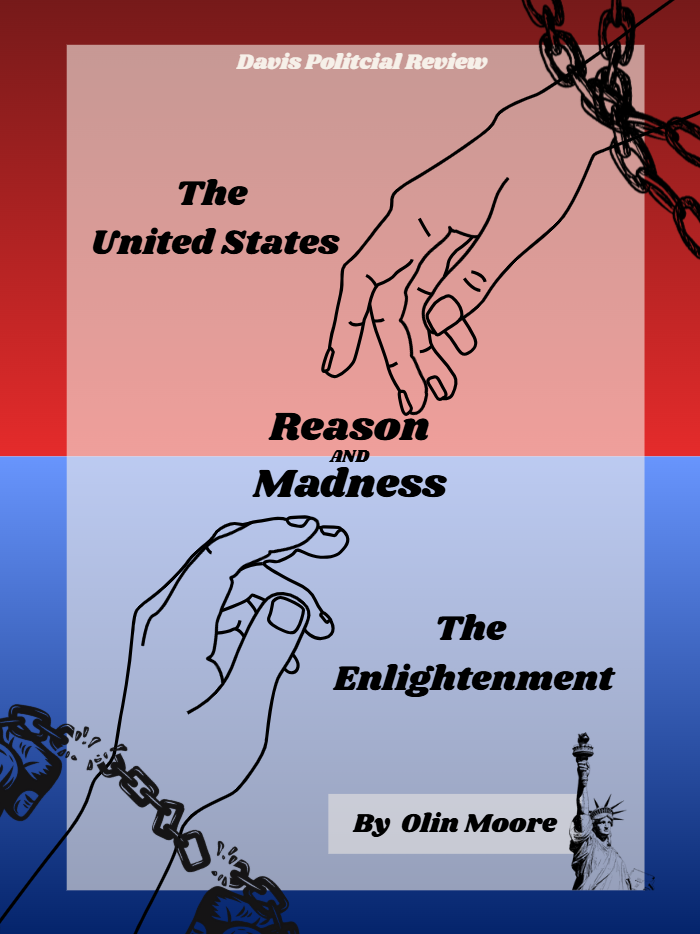
Art Credit: Mai Preisser
The Age of Enlightenment is marked as one of the most transformative periods in human history. From the late 17th to the 18th Century, major advancements in various fields and studies reshaped mankind’s interpretation of the world around it. This is most apparent in the field of political philosophy. Great thinkers such as Thomas Hobbes, John Locke, and Jean-Jacques Rousseau pioneered many progressive political concepts that proved inspirational; their ideas eventually imprinted upon the fledgling United States of America in its struggle for independence and beyond. In many ways, the young republic was the instantiation of Enlightenment thought, boasting a government that was radically unlike any other at the time. As retrospective demystifies our judgements, the reputation that it has earned over time may be an inaccurate one. Whereas its culture pontificates liberty, freedom, and equality, the pressing weight of reality paints a different picture. Upon inspection, it seems as though the United States fails to meet the lofty expectations that it and the Age of Reason espoused.
Before understanding the intellect of the Enlightenment, the world that it inherited must be described. At its dawn, Europe largely remained a place of ancient customs. Much of the continent remained subject to the archaic workings of traditional conceptions of civilization. In some areas, serfdom was still in place, monarchy remained the standard form of government, and Christianity – though fractured – still dominated the lives of over one hundred million. Common among many of the autocracies across Europe was the use of divine right or heredity as justification for ruling, which had endured for over a millennium. Of course, this cannot be claimed for all despotic regimes; nonetheless, the will of the people was rarely cited as a genuine basis for imperium.
However, this attitude towards legitimacy began to shift in 1651 with the publication of Thomas Hobbes’ seminal work, Leviathan. In it, the notion of a government formed with the consent of those being ruled was presented. Elements of a social contract theory in the West can be found as early as the classical period, but Hobbes is largely credited as the first theorist to formulate the social contract as we understand it in modern political philosophy. While many of his further ideas are largely impractical and skeptical, Hobbes’ text serves as an important and highly influential piece in the history of Western political thought.
Only a few decades later, John Locke postulated his own contract in the Second Treatise of Government in 1689. Although similar in some respects, his interpretations differed from Hobbes’ in that he based many of his concepts on a theory of private property (which he assured could exist in the absence of organized government) as well as total moral equality. Hobbes, on the other hand, asserted equality through mortality and the impossibility of private ownership without government. The French philosopher Jean-Jacques Rousseau went on to publish The Social Contract almost a century later in 1762, but while highly influential in its own right, its direct effect on the founding fathers is debated. Regardless, the three agreed that some form of social contract was necessary for functional political life, a provocative and significant idea that carried further implications.
With traditional legitimacy being questioned, alternative forms of government that rooted their validity in more rational metrics found popularity. For many Enlightenment philosophers, a hereditary or divine monarchy could not adequately represent the interests of its citizens. Not only was the consent of the people ignored, but many of the unelected autocrats were contemptuously ignorant of the lives of their subjects, a fact which would play a part in the then brewing French Revolution. As such, republican sentiment emerged for those weary of autocratic rule. Most famously, the Thirteen Colonies drew republican inspiration from men such as Rousseau, Montesquieu, and even older sources like the Roman Republic and ancient Greece. The early settlers felt that they had little sway over the government that they were subject to; as such, it did not adequately represent them. The result was a movement imbued with republicanism, evidenced not only in its government but in its culture as well. Ideals of civic virtue and moral citizenship ingrained themselves within American communities at every level. The formation of local militias during the colonial period and its reiteration as the Second Argument can arguably be viewed as a product of the polis-over-individual attitude of patriotism and civic virtue.
Overtly liberal concepts have also found a home in the United States. Notions of natural rights, limited government authority, and practices of equality are integral to our constitutional republic. In particular, the natural rights espoused by Locke – life, liberty, and property – proved foundational. Two of his rights made it into the Declaration of Independence, with the third being changed to the more socially liberal “pursuit of happiness” by Thomas Jefferson. Despite this, property relations remained staunchly defended through protections like the 5th Amendment, guaranteeing that (among other things) property would not be confiscated without due process. In fact, much of the Bill of Rights and Amendments have focused on the preservation and expansion of individual liberties.
The French philosopher Montesquieu made his own highly influential contributions to American liberalism. In his 1748 treatise The Spirit of Laws, he advocated for a government separated into three branches – executive, legislative, and judicial – with a system of checks and balances to prevent imbalances of power. He also perceived the goal of law as upholding public order and security while affording individuals the liberty to lead their lives as they otherwise saw fit, the essence of which has permeated throughout American law. He would also prove inspirational for another Enlightenment theorist revered by the Founding Fathers.
Only a generation later, that man – Italian jurist Cesare Beccaria – penned On Crimes and Punishments in 1764 (copies of which reached Thomas Jefferson and John Adams). In it, he expanded on Montesquieu’s theories of law as a means to uphold the social contract. Some further arguments made include those against the death penalty, the necessity of the right to bear arms, as well as advocacy for proportional, speedy, and public punishments. In this way, his ideas in some form influenced the Second (the right to bear arms), Fifth (due process), Sixth (a speedy and public trial), and Eighth (no cruel or unusual punishment) Amendments. The rational, humanitarian version of law that the Western world and the United States have enjoyed in the last three centuries can largely be traced back to Beccaria’s work.
Religion was also of major concern for the Founding Fathers. Keeping with enlightenment ideals, Thomas Jefferson, Ben Franklin, and James Madison (among others) agreed with Locke’s A Letter Concerning Toleration in that religious toleration should be practiced. This was a revolutionary concept for its time; in many parts of Europe, religion was deeply intertwined with government. Most countries held state religions which were some form of Christian denomination, and it had played a major role in the previous century’s devastating Thirty Years’ War. Forced religious dissemination had also served as a primary motivation for European imperialism and the growth of colonial empires. By diverging from the religious intolerance of the old world, the United States was (in theory) allowed to turn its back on centuries of religious dogmatism, escape the horrors of another potential Thirty Years’ War, and foster a uniquely cosmopolitan culture.
This synthesis of Enlightenment thought certainly presents one with a picture of a utopian society. The premise of a nation founded on the foremost political ideals of progress and equality, coupled with an absence of complicated monarchic or religious history, seems like an unsurpassable combination. In short, the United States was perhaps the best country to realize the full implications of the Enlightenment. However, in practice, America falls short of the ideals of the Age of Reason and its own.
Fundamentally, it was not the cosmopolitan or rational society that it hoped it could be. Before any other considerations, it must be noted that the United States was founded and expanded through the unreasonable seizure of Native American lands, forcing them off ancestral places that they had occupied for centuries. Relations deteriorated as Americans expanded further West and continued to impose their civilization on the indigenous peoples through the guise of “Manifest Destiny”. Most groups were forced into dismal conditions on reservations, while millions perished from violence and illness. After they were subjugated, Native Americans have since undergone a process of cultural genocide as they have assimilated to western society. This alone should serve to completely dismantle the American reputation.
Unfortunately, this is not the only stain on the fabric of our short history. At the birth of America, 3.1% of its population, or some 700,000 individuals, were enslaved. While founding fathers such as John Adams, Benjamin Franklin, and Alexander Hamilton were abolitionists and the United States always maintained some opposition to slavery, the debate between freedom and enslavement was settled in favor of the unity of our young republic, and slavery was allowed to endure. Millions would remain enslaved until 1865, but even beyond then, Jim Crow would plague the country for another century. Groups like Italian, Irish, and Chinese immigrants have also faced prejudice due to stereotypes and religious intolerance, and were often subject to ethnic isolation. This obviously undermines the equality and worldliness that have been so prominent in theory; these instances signify a series of deep moral failures that contradict the very ideals of the revolution that brought about their instantiation.
Despite the Founding Fathers’ distaste for autocracy and their attempts to disseminate power over a wider authority, representation remained limited. At its inception, the United States generally allowed for only white, property-owning males to vote, around 6% of the population. Over time, the voter base would only expand; the 19th Amendment, ratified in 1920 and the Voting Rights Act of 1965 serve as notable examples. We certainly seem to be in an age of unprecedented political representation, but the republican visions of the Enlightenment remain unrealized in less obvious ways. More wealth is concentrated in the hands of fewer individuals than ever before, allowing them to wield massive political influence. This has had the effect of seriously undermining our constitutional republic. In fact, some have begun to classify the United States as a “functional oligarchy” due to the disproportionate favoritism of the wealthy, corporations, and business groups over average citizens. As a result, ideals of civic virtue and genuine representation are being cast aside in favor of profit and the agendas of a small elite.
In recent years, the United States has fallen short in other ways. Since 2001, islamophobia has remained a pervasive and consistent issue which culminated in a series of travel bans targeting predominantly Muslim nations during the first Trump Administration. Fast forwards to his second term, and the U.S. Immigration and Customs Enforcement agency has been illegally detaining individuals, violating the constitutionally enforced due process derived from Beccaria. The continuing and successful attempts of executive empowerment by President Trump have also served to degrade the checks and balances of the tripartite government espoused by Montesquieu, much to his chagrin.
And that is only the surface; these examples serve as a nonexhaustive list showing some of the most notable ways in which America has consistently failed to live up to the expectations set by itself and the preceding Age of Enlightenment.
This begs the question: Will the United States ever achieve these lofty ambitions? Considering this from the present, it remains uncertain. The overall picture presented is one of a nation that has a history of racial and ethnic discrimination, religious prejudice, dubious republican representation, and discretional disregard for its own laws and statutes. Not a very flattering picture. However, time has certainly brought this country closer to realizing the essence of the Enlightenment. Great strides in progress have been made over the centuries; as mentioned, more people than ever can vote and exercise their voices. Racial discrimination, though still felt, is a fraction of what it once was and despite current issues, religious tolerance has increased significantly. Furthermore, a cosmopolitan culture is evident almost anywhere in the country explicitly or implicitly. Clearly, the hope and ability of change has never definitively failed America. If our history has demonstrated anything, it is that the march of progress, though often slow and sometimes glacial, is unstoppable.