
What California’s Billionaire Tax Act Reveals About Its Larger Fiscal Problem
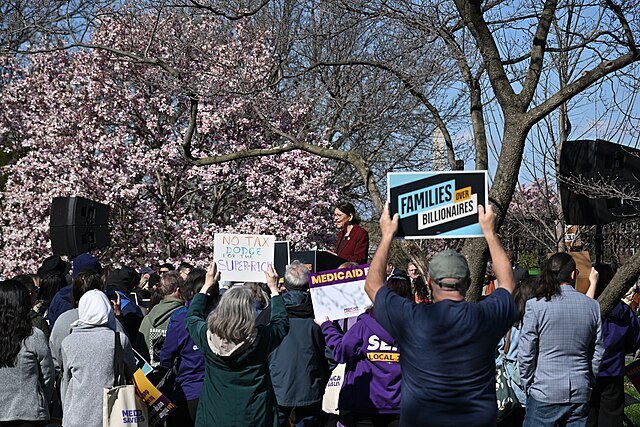
Photo Credit: G. Edward Johnson
The 2026 Billionaire Tax Act is a proposed ballot initiative that would impose a one-time 5% excise tax on the accumulated wealth of California billionaires. The measure was brought forward by Suzanne Jimenez, the Chief of Staff for the healthcare labor union, Service Employees International Union-United Healthcare Workers West (SEIU-UHW). The proposal was motivated by the belief that establishing an emergency fund for Medi-Cal and its foundations would help mitigate a projected $19 billion annual loss resulting from federal funding cuts. To address this gap, Jimenez projects that the tax would generate $100 billion that would be transferred to the Billionaire Tax Health Account. It would also address state-level cuts to Medi-Cal.
While acknowledging the significant and complex issues arising from recent federal budget legislation, the Act’s stated goal of stabilizing Medi-Cal funding fundamentally misdefines wealth by taxing voting control as ownership, forcing destructive asset liquidation, threatening capital flight, and ultimately functioning as a one-time revenue grab that avoids the difficult but necessary work of correcting California’s structural budget deficit.
A recent analysis by the Tax Foundation, a nonpartisan tax policy organization, lays out the economic reality of California’s proposed billionaire wealth tax: it would extend far beyond the advertised one-time 5% levy on liquid wealth. The tax in practice redefines net worth to include voting control, regardless of whether that control reflects the taxpayer’s actual economic state. The initiative treats control as ownership, so if a founder’s voting or control rights exceed their actual equity stake (super-voting shares), the tax is calculated using the higher control percentage rather than their actual ownership.
This tax would effectively create phantom wealth by treating voting shares as tradeable, publicly valued assets, even when the shares cannot be sold to the public without first being converted to common stock. This treatment is incoherent because it may tax interests the taxpayer does not actually possess and can result in tax liability calculated based on a valuation that does not reflect the actual market value of the shares held. Since the tax treats control rights as a proportional share of the company’s total value, it can generate massive tax bills that are disproportionate to the taxpayer’s ability to pay, without liquidating their position. In other words, to satisfy tax liabilities, founders would likely be forced to convert their super-voting shares into common stock and sell them, thereby relinquishing control of the company and potentially “dumping vast holdings” into the market.
To understand the mismatch between voting or control rights and company equity ownership, the Tax Foundation analysis offers a concrete example: DoorDash founder Tony Xu. Xu owns only 2.6% of DoorDash’s equity; however, he holds super-voting shares that give him control of 57.6% of the company’s voting rights. As stated previously, the tax initiative mandates that the taxpayer’s ownership “be presumed as not less than their percentage of overall voting or direct control rights.” So, for the tax, Xu will be treated as if he owns 57.6% of the company’s value, even though his economic stake is much smaller than that. Based on this assumption, the Tax Foundation estimates that his tax liability alone is $2.63 billion, which exceeds the total market value of his shares at $2.41 billion. To pay this substantial bill, Xu will be forced to sell his shares, triggering federal and state capital gains taxes. When these liquidation costs are added, his total tax liability for his DoorDash shares will rise to $4.17 billion, representing 173% of their value. This demonstrates the extent of the mismatch, as the tax would bankrupt Xu. As the Tax Foundation notes, the valuation is highly inflated, so the Franchise Tax Board (FTB) would step in to set it aside. However, this underscores that, by design, the tax misunderstands wealth.
As a secondary, simpler risk, the tax poses a risk of capital flight. California is already heavily dependent on a very small group of people for its budget. The top 1% of earners provide almost half of the state’s personal income tax revenue and, due to the state’s progressive tax structure, bear the highest tax rates as well. Prominent individuals such as Google co-founders Larry Page and Sergey Brin have already been seen leaving the state, and when they leave, the state loses more than just potential wealth tax revenue; it also loses their personal income, sales, and real estate tax revenue. An obvious thought also arises: billionaires are not tied down to California. They can change residency with ease by purchasing a new property elsewhere; more business-friendly cities, such as Austin, Texas, are emerging, while California provides the opposite incentives. When California already relies on a narrow, fragile tax base, losing these key individuals and their staff can reduce projected tax revenue at a time when the state faces a multiyear budget deficit that requires a stabilized revenue source to make any progress toward fiscal responsibility and accountability.
Before we discuss where the tax revenue will be allocated, we must first review the nonpartisan Legislative Analyst’s Office (LAO)'s projected $18 billion deficit for the 2026-27 fiscal year and its structural implications for future deficits and for funding programs beyond Medi-Cal. This estimate marks the fourth consecutive year California has faced a deficit under Governor Newsom, despite tax revenue growth driven by the AI boom. LAO indicates that this recurring problem is “structural rather than cyclical,” as deficits persist even when the California economy is growing. LAO notes that the state’s revenues are growing above historical averages but remain insufficient to cover current spending levels. The state shows no inclination to move toward greater fiscal discipline, as the LAO projects that the structural deficit could range between $20 to $35 billion annually for the next fiscal year.
Addressing a structural deficit requires sustainable revenue streams, spending reductions, or both, and to cover just half of the projected multiyear deficits, LAO estimates the state needs at least $10 billion more annually in ongoing solutions. Governor Newsom’s budget proposal will cover only $5 billion in ongoing spending solutions, which will inevitably fail to address projected deficits. The state is relying on short-term solutions, such as a wealth tax, to address a structural issue and continues to avoid the real “difficult” work of realigning ongoing spending with ongoing revenue. A one-time patch, rather than budget reform, outside the General Fund, ignores the real problems that keep arising from fiscal irresponsibility; it will not slow spending growth and will not stabilize revenue.
The Billionaire Tax Act is structured on ignorance of the General Fund’s current deficit. The tax revenue is designated to a “special fund, permanently separate and apart from the General Fund,” effectively creating a protected fund for healthcare while the rest of the budget remains in a chronic deficit. It is important to recognize that the Act was explicitly designed to address a projected loss of up to $19 billion in annual federal funding for Medi-Cal, and that the state must address gaps to offset these cuts. This means that California must reconsider how to allocate Medi-Cal, including difficult choices about eligibility and benefit levels, and this tax is only one of the many solutions under consideration. However, we cannot ignore that Medi-Cal is inseparable from California’s fiscal identity, as it currently accounts for 20% of overall General Fund spending, according to the LAO. Treating healthcare as an isolated expense ignores the central message for future fiscal sustainability, where California must realign ongoing spending with ongoing revenue across the entire budget.
The Act also explicitly states that the new Revenue Fund cannot be used to justify “reducing, eliminating, or failing to increase” existing state appropriations, treating the multiyear deficit as a given and precluding potential solutions to slow spending. It will seek to restore or address any reductions made, thereby locking in current spending levels that have already proven disastrous, without regard for the state’s overall ability to pay.
The LAO’s criticism of past budget failures was that the state relied on “mostly short-term solutions rather than realigning its structural shortfalls.” We can see this pattern repeated in the Billionaire Tax Act, which addresses a persistent problem in the same way as before. If California needs $10 billion annually in ongoing solutions to reduce multiyear deficits, the wealth tax provides only a one-time infusion of cash that will not address the underlying drivers of costs that simply cannot keep up with revenue.
The debate over the Billionaire Tax Act raised questions about whether the state is willing to confront the structural causes of its fiscal instability, over whether the ultra-wealthy should contribute. By design, the measure relies on a mechanically flawed understanding of wealth that disconnects tax liability from a taxpayer’s economic reality, while offering no solution to the structural deficit. Creating a separate, dedicated fund treats persistent overspending as inevitable and delays broader budget reform. The Billionaire Tax Act will not correct California’s fiscal challenges, and the state must recognize that budget reform will be necessary and will require difficult choices regarding the alignment of spending and revenue across the entire budget.